Graphical Abstract
Abstract
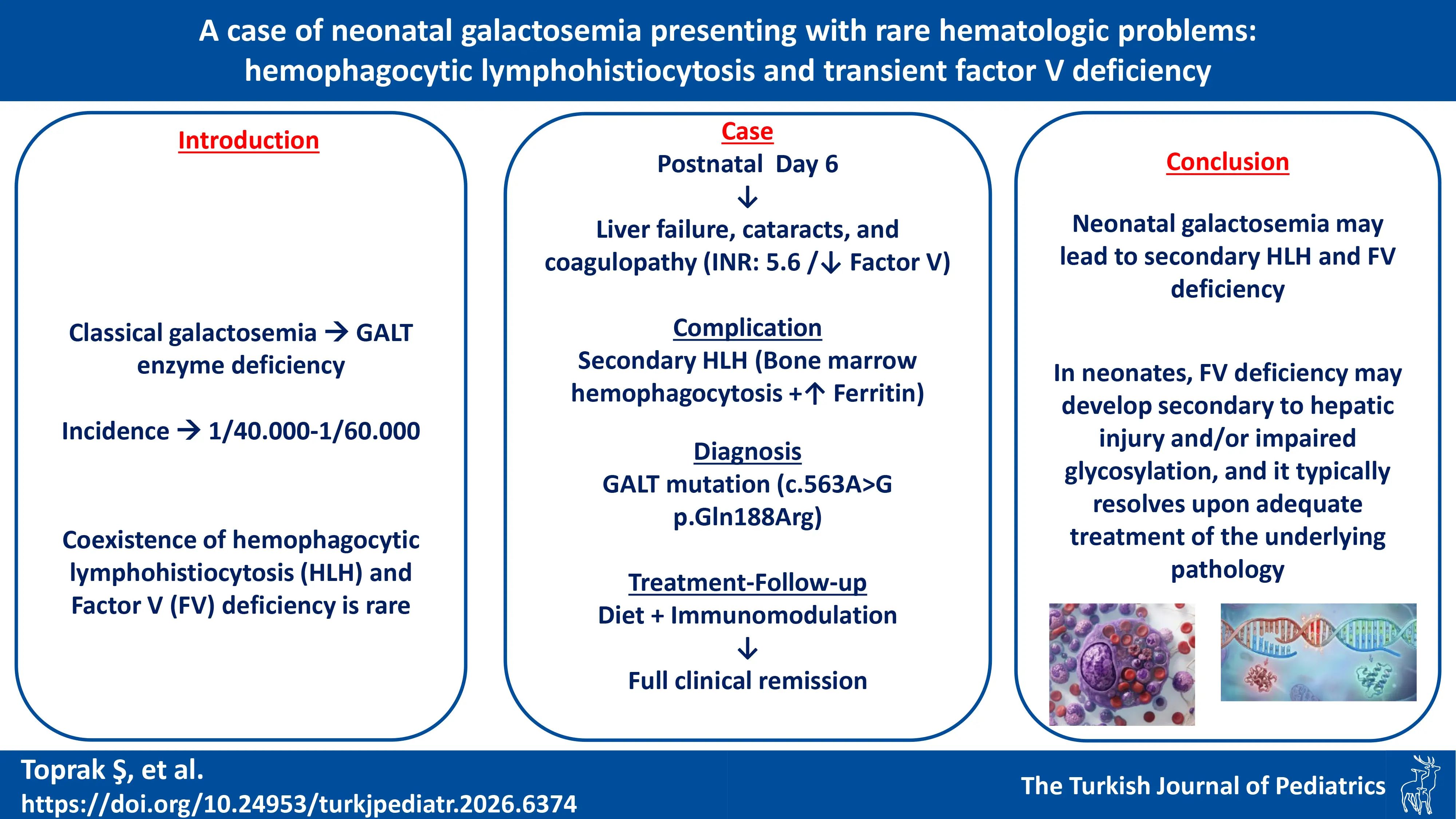
Background. In the neonatal period, classical galactosemia usually presents with nonspecific clinical signs such as feeding intolerance, jaundice, lethargy, hypotonia, vomiting, and failure to thrive. Hemophagocytic lymphohistiocytosis (HLH) is very rare, with only a few case reports. The mechanism of HLH in metabolic disorders is unclear. It is thought to be related to tissue damage and impaired lymphocyte and histiocyte function, or some form of macrophage activation through metabolite accumulation. Various exogenous agents can inhibit factor V (FV) secretion or reduce its activity by inhibiting sulphatization, glycosylation, or phosphorylation.
Case Presentation. Here we report the case of a newborn who presented with elevated prothrombin time and activated partial thromboplastin time in the setting of liver failure and transient low FV levels and was subsequently diagnosed with HLH secondary to galactosemia.
Conclusion. Neonatal galactosemia can lead to secondary HLH and transient FV deficiency. Our experience suggests that FV deficiency in neonates with galactosemia may develop secondary to liver damage and/or impaired glycosylation, and resolves with adequate treatment of the underlying disease.
Keywords: galactosemia, factor V, hemophagocytic lymphohistiocytosis, neonate
Introduction
Galactosemia is an autosomal recessive (AR) congenital inborn disorder of carbohydrate metabolism characterized by an inability to convert galactose to glucose due to a deficiency of one of the enzymes galactose-1-phosphate uridylyltransferase (GALT), galactokinase or galactose-4-epimerase. Galactosemia is most commonly caused by a deficiency of the enzyme GALT and is known as classical galactosemia. The incidence of galactosemia varies between 1/40,000-1/60,000.1-3
Infants with classical galactosemia present with various findings including jaundice, vomiting, hepatomegaly, failure to thrive, poor feeding, and sepsis.3 Hemophagocytic lymphohistiocytosis (HLH) associated with classic galactosemia is exceedingly rare. To the best of our knowledge, only three cases have been reported in the literature to date.4-6 Only one case of classical galactosemia with coagulopathy due to factor V (FV) deficiency has been reported in the literature.7
We present this case to emphasize that neonatal galactosemia can lead to secondary HLH and transient FV deficiency.
Case Presentation
A male infant was born with a birth weight of 3340 g at 37 weeks of gestation by elective Caesarean section to a 25-year-old mother. APGAR scores were 9 and 10 at 1 and 5 minutes of life. The infant was admitted to the neonatal intensive care unit because of tachypnea, grunting and cyanosis, which improved with nasal continuous positive airway pressure (CPAP) within 24 hours. The parents were first cousins. The obstetric history was notable for three prior pregnancy losses, while one sibling was healthy. The mother had used low molecular weight heparin during pregnancy due to heterozygous polymorphisms in the MHTFR (1298A>C), F12 (factor XII; V34L) and PAI1 (plasminogen activator inhibitor-1; 4G/5G) genes. Hemogram, acute phase reactants (procalcitonin and C-reactive protein), blood glucose, electrolytes, renal and hepatic function tests were within normal limits at 24 hours of life. The patient could not be discharged due to poor sucking and was fed via orogastric tube. On postnatal day 6, he developed jaundice, mild hypotonia, hepatomegaly, and >15% weight loss.
Laboratory tests revealed (normal values in parentheses): white blood cell count 14.08 x10³/µL, hemoglobin 17 g/dL, platelets 216x103/µL, alanine aminotransferase (ALT): >700 U/L (0-41 U/L), aspartate aminotransferase (AST): 1955 U/L (0-40 U/L), total bilirubin (TB): 11.2 mg/dL, direct bilirubin (DB): 2.15 mg/dL, gamma glutamyltransferase (GGT): 125 U/L (0-60 U/L), alkaline phosphatase: 1089 U/L (122-469 U/L), lactate dehydrogenase (LDH): 2271 U/L (0-250 U/L), total protein: 4.8 g/dL (4.6-7 g/dL), albumin: 3.7 g/dL (3.8-5.4 g/dL), prothrombin time (PT): 56 s (9.9-11.8 s), activated partial thromboplastin time (aPTT): >100 s (23-31.9 s), international normalized ratio (INR): 5.69 (0.7-1.2). Mixing test showed improvement. Vitamin K and fresh frozen plasma (FFP) were administered and ursodeoxycholic acid (UCDA) was initiated. Although transaminases decreased, direct bilirubin and coagulation parameters remained abnormal. Hepatobiliary and cranial ultrasonography (US) were normal. Echocardiography showed a patent foramen ovale, and patent ductus arteriosus. Toxoplasma, rubella, cytomegalovirus, herpes simplex virus, Ebstein-Barr virus, parvovirus B19 and mumps virus serologies were negative. Blood and urine cultures were negative. Metabolic screening revealed normal ammonia, lactate, and pyruvate levels but positive urine reducing substances. Thin-layer chromatography was performed. Among the common pathway factors, factor I (1.07 g/L), FV (15% and 9.8%) and factor X (65.3%) were tested, revealing a low FV activity.
On postnatal day 13, ALT: 90 U/L, AST: 240 U/L, TB: 11.2 mg/dL, DB: 5.3 mg/dL were found. Laboratory analysis revealed bicytopenia (hemoglobin: 9.9 g/dL, platelets: 86 x103/µL), low fibrinogen (1.07 g/L), high ferritin (1510 ng/mL) and high LDH (1364 U/L) levels. Monocytosis, vacuolization of monocytes and atypical lymphocytes were seen on peripheral blood smear. Bone marrow aspirate (Wright-Giemsa stain) showed no storage cells. Blasts and atypical lymphocytes were less than 5% but hemophagocytosis (red blood cell, nucleated erythrocyte precursors and granulocytes) was observed in each quadrant of the bone marrow aspirate. The patient was diagnosed with HLH and treated with intravenous immunoglobulin (IVIG) and prednisolone, resulting in laboratory (bicytopenia, AST, ALT, LDH and ferritin) improvement. Blood and urine amino acid analysis showed generalized elevations, particularly glycine, phenylalanine and tyrosine, which were normalized on follow-up. Therefore, transient generalized amino acid elevation secondary to liver failure rather than inherited metabolic diseases was considered. On postnatal day 24, bilateral nuclear sclerosis in the eye lens was found, and urine galactose testing was positive. A galactose-free formula was started. Genetic analysis identified a homozygous NM_000155.4: c.563A>G (p.Gln188Arg) mutation in exon 6 of the GALT gene.
The second FV activity measurement was found to be lower than the first one (15% vs 9.8%). The infant started to gain weight after galactose-free formula and was discharged on the 38th day of life. No perforin gene (PRF1) mutations were present in the analysis performed for familial HLH. In addition, FV activity was found to be within normal limits (67.7%) in the pediatric hematology outpatient follow-up (controls were performed at 2nd, 3rd, 4th and 6th months). Bilateral nuclear sclerosis regressed on follow-up. At 20 months of age, the patient demonstrated appropriate neurodevelopmental milestones.
Informed consent was obtained from the parents of the case for the publication.
Discussion
In this report, we describe a neonate with classical galactosemia who developed early liver dysfunction accompanied by severe coagulopathy, transient FV deficiency, and secondary HLH. Although hepatic involvement is well recognized in galactosemia, the coexistence of HLH and marked coagulation abnormalities appears to be uncommon and may complicate the initial clinical evaluation.
Classical galactosemia in the neonatal period may initially manifest with mild and nonspecific symptoms. However, if left untreated, the clinical course can rapidly progress to severe systemic complications. These include hepatomegaly, acute liver failure, renal dysfunction, encephalopathy, and an increased risk of Escherichia coli sepsis, potentially leading to shock and death.2,3 Symptoms typically become evident within the first one to two weeks after the initiation of milk feeding. Coagulopathy secondary to liver involvement may also occur and can be managed with vitamin K and FFP. Early recognition and prompt initiation of a galactose-restricted diet are therefore crucial to prevent life-threatening outcomes.8
In galactosemia-associated liver injury, supportive treatment alone is usually insufficient for meaningful hepatic recovery.9,10 In our case, although liver failure signs partially improved with supportive therapy, cholestasis and coagulation parameters did not improve until a galactose-free diet was initiated, highlighting the critical role of dietary management in reversing hepatic dysfunction.
Galactose levels can be mildly elevated in normal newborns (6–10 mg/dL), which may lead to false-positive results. Other causes of elevated galactose include liver dysfunction due to conditions such as portosystemic vascular shunts, biliary atresia, and Fanconi–Bickel syndrome.11-13 In our case, hepatobiliary ultrasonography showed no pathological findings.
Hemophagocytic lymphohistiocytosis is a rare, life-threatening hyperinflammatory disease caused by impaired function of natural killer cells and cytotoxic T cells and overactivation of macrophages and T lymphocytes. Primary HLH, also known as familial HLH, is an autosomal recessive disease that is more common when there is consanguinity between parents. Secondary HLH occurs following severe immunologic activation such as immunodeficiency, systemic infection, autoimmune diseases, metabolic diseases or malignancy.6,14 The mechanism of HLH in metabolic diseases is not clear. It is thought to be related to tissue damage and impaired lymphocyte and histiocyte functions or somehow activation of macrophages through accumulation of metabolites.15,16 The association between galactosemia and HLH has been reported in only three cases to date, with the third case described by Kundak et al.4-6 In that report, the patient with HLH secondary to galactosemia presented with fever, hemophagocytosis, hypofibrinogenemia, pancytopenia, splenomegaly, and hyperferritinemia, and was treated with IVIG.6 In our case, when HLH was diagnosed on day 13, galactosemia had not yet been confirmed. Therefore, it was unclear whether the HLH was primary or secondary. Current consensus guidelines recommend early treatment for familial HLH and suggest that prompt immunomodulatory therapy may also be beneficial in secondary HLH.17 Although neonatal data are limited, therapy targeting hyperinflammation should be initiated without delay after diagnosis.18We initiated immunomodulatory therapy to stabilize the patient during the acute phase. To our knowledge, this represents the fourth reported case of this association in the literature.
No perforin (PRF1) gene mutation was identified in our patient. However, the absence of further genetic testing, including analysis of other HLH-related genes or whole-exome sequencing, represents a limitation of this report.
Factor V has both procoagulant and anticoagulant functions within the coagulation cascade. Although mild mucosal bleeding is the most common clinical manifestation, life-threatening bleeding may also be observed.7,19 Approximately 75-80% of FV is synthesized in hepatocytes and hereditary deficiency is extremely rare (1 per million).19,20 Therefore, when low FV levels are detected, liver disease, disseminated intravascular coagulation, and FV inhibitors should be considered first.20 Numerous posttranslational changes can be observed in the FV pro-peptide, including sulphatization, phosphorylation, glycosylation and formation of disulfide bridges. Various exogenous agents can inhibit FV secretion or reduce its activity through inhibition of sulphatization, glycosylation or phosphorylation.20
Only one case of galactosemia associated with FV deficiency has been reported in the literature prior to ours. Mansouritorghabeh et al.7 reported a newborn diagnosed with “hereditary” FV deficiency who died of pulmonary hemorrhage before initiation of a lactose-free diet. Notably, no genetic analysis confirming hereditary deficiency was provided and the transient or secondary nature of the deficiency could not be excluded.7 In contrast, FV levels normalized after treatment of galactosemia in our patient, supporting the interpretation that the deficiency was secondary to liver dysfunction rather than a true hereditary defect. Nevertheless, as only common pathway factors were evaluated, the potential involvement of other coagulation factors remains a limitation of our report.
In conclusion, based on the follow-up of our case, FV deficiency in neonates with galactosemia may develop secondary FV deficiency related to liver damage and/or impaired glycosylation, and improve with adequate treatment of the underlying disease.
Ethical approval
Informed consent was obtained from the patient’s parents for the publication.
Source of funding
The authors declare the study received no funding.
Conflict of interest
The authors declare that there is no conflict of interest.
References
- Fridovich-Keil JL, Walter JH. Galactosemia. In: Scriver CR, Beaudet AL, Sly WS, Valle D, editors. The metabolic and molecular bases of inherited disease. 8th ed. New York, NY: McGrawHill Medical Publishing Division; 2008: 72.
- Cerone J, Rios A. Galactosemia. Pediatr Rev 2019; 40: 24-27. https://doi.org/10.1542/pir.2018-0150
- Çelik M, Akdeniz O, Ozbek MN, Kirbiyik O. Neonatal classic galactosemia-diagnosis, clinical profile and molecular characteristics in unscreened Turkish population. J Trop Pediatr 2022; 68: fmac098. https://doi.org/10.1093/tropej/fmac098
- Marcoux MO, Laporte-Turpin E, Alberge C, et al. Congenital galactosaemia: an unusual presentation. Arch Pediatr 2005; 12: 160-162. https://doi.org/10.1016/j.arcped.2004.10.019
- Yaralı N, Yıldırım I, Arık E, Zorlu P, Tanır G. Hemophagocytic syndrome associated with bacterial infections. J Pediatr Inf 2010; 4: 162-164.
- Kundak AA, Zenciroğlu A, Yaralı N, et al. An unusual presentation of galactosemia: hemophagocytic lymphohistiocytosis. Turk J Haematol 2012; 29: 401-404. https://doi.org/10.5505/tjh.2012.65148
- Mansouritorghabeh H, Sharifi-Hoseini MR, Shahroudian M. Inherited factor V deficient neonate with galactosaemia. Clin Biochem 2012; 45: 356-358. https://doi.org/10.1016/j.clinbiochem.2011.12.024
- Öztürk Y, Erdur B, Tokgöz Y. Clinical features of the patients with classic galactosemia. Türkiye Klinikleri J Pediatr 2010; 19: 16-19.
- Yuzyuk T, Viau K, Andrews A, Pasquali M, Longo N. Biochemical changes and clinical outcomes in 34 patients with classic galactosemia. J Inherit Metab Dis 2018; 41: 197-208. https://doi.org/10.1007/s10545-018-0136-9
- Porta F, Pagliardini S, Pagliardini V, Ponzone A, Spada M. Newborn screening for galactosemia: a 30-year single center experience. World J Pediatr 2015; 11: 160-164. https://doi.org/10.1007/s12519-015-0017-3
- Ono H, Mawatari H, Mizoguchi N, Eguchi T, Sakura N. Clinical features and outcome of eight infants with intrahepatic porto-venous shunts detected in neonatal screening for galactosaemia. Acta Paediatr 1998; 87: 631-634. https://doi.org/10.1080/080352598750014021
- Müller D, Santer R, Krawinkel M, Christiansen B, Schaub J. Fanconi-Bickel syndrome presenting in neonatal screening for galactosaemia. J Inherit Metab Dis 1997; 20: 607-608. https://doi.org/10.1023/a:1005375629820
- Sakura N, Mizoguchi N, Ono H, Yamaoka H, Hamakawa M. Congenital biliary atresia detected as a result of galactosemia screening by the Beutler method. Clin Chim Acta 2000; 298: 175-179. https://doi.org/10.1016/s0009-8981(00)00220-5
- Canna SW, Marsh RA. Pediatric hemophagocytic lymphohistiocytosis. Blood 2020; 135: 1332-1343. https://doi.org/10.1182/blood.2019000936
- Filipovich AH. The expanding spectrum of hemophagocytic lymphohistiocytosis. Curr Opin Allergy Clin Immunol 2011; 11: 512-516. https://doi.org/10.1097/ACI.0b013e32834c22f5
- Salooja N, Martin P, Khair K, Liesner R, Hann I. Severe factor V deficiency and neonatal intracranial haemorrhage: a case report. Haemophilia 2000; 6: 44-46. https://doi.org/10.1046/j.1365-2516.2000.00362.x
- Hines MR, von Bahr Greenwood T, Beutel G, et al. Consensus-based guidelines for the recognition, diagnosis, and management of hemophagocytic lymphohistiocytosis in critically ill children and adults. Crit Care Med 2022; 50: 860-872. https://doi.org/10.1097/CCM.0000000000005361
- McLean J, Katebian R, Suh E, Mirza K, Amin S. Neonatal hemophagocytic lymphohistiocytosis. Neoreviews 2019; 20: e316-e325. https://doi.org/10.1542/neo.20-6-e316
- Tabibian S, Shiravand Y, Shams M, et al. A comprehensive overview of coagulation factor V and congenital factor V deficiency. Semin Thromb Hemost 2019; 45: 523-543. https://doi.org/10.1055/s-0039-1687906
- Mann KG, Kalafatis M. Factor V: a combination of Dr Jekyll and Mr Hyde. Blood 2003; 101: 20-30. https://doi.org/10.1182/blood-2002-01-0290
Copyright and license
Copyright © 2026 The Author(s). This is an open access article distributed under the Creative Commons Attribution License (CC BY), which permits unrestricted use, distribution, and reproduction in any medium or format, provided the original work is properly cited.