Graphical Abstract
Abstract
Background. Early feeding skills and general movements (GMs) are negatively affected by hypotonia due to prematurity. Interventions for feeding skills can be guided by understanding the relationship between feeding skills and GMs. In the light of this, the study focused on understanding the relationship between early feeding skills and preterm infants’ GMs in the neonatal intensive care unit (NICU).
Methods. Participants in this cross-sectional study were forty infants with a postmenstrual age of 34–37 weeks who were hospitalized in the NICU at Abant İzzet Baysal University Training and Research Hospital. The data consisted of demographic characteristics (birth weight, gestational age, date of birth, age, and sex), feeding skills, assessed with the Early Feeding Skills Assessment Tool, and GMs, assessed with the General Movement Assessment.
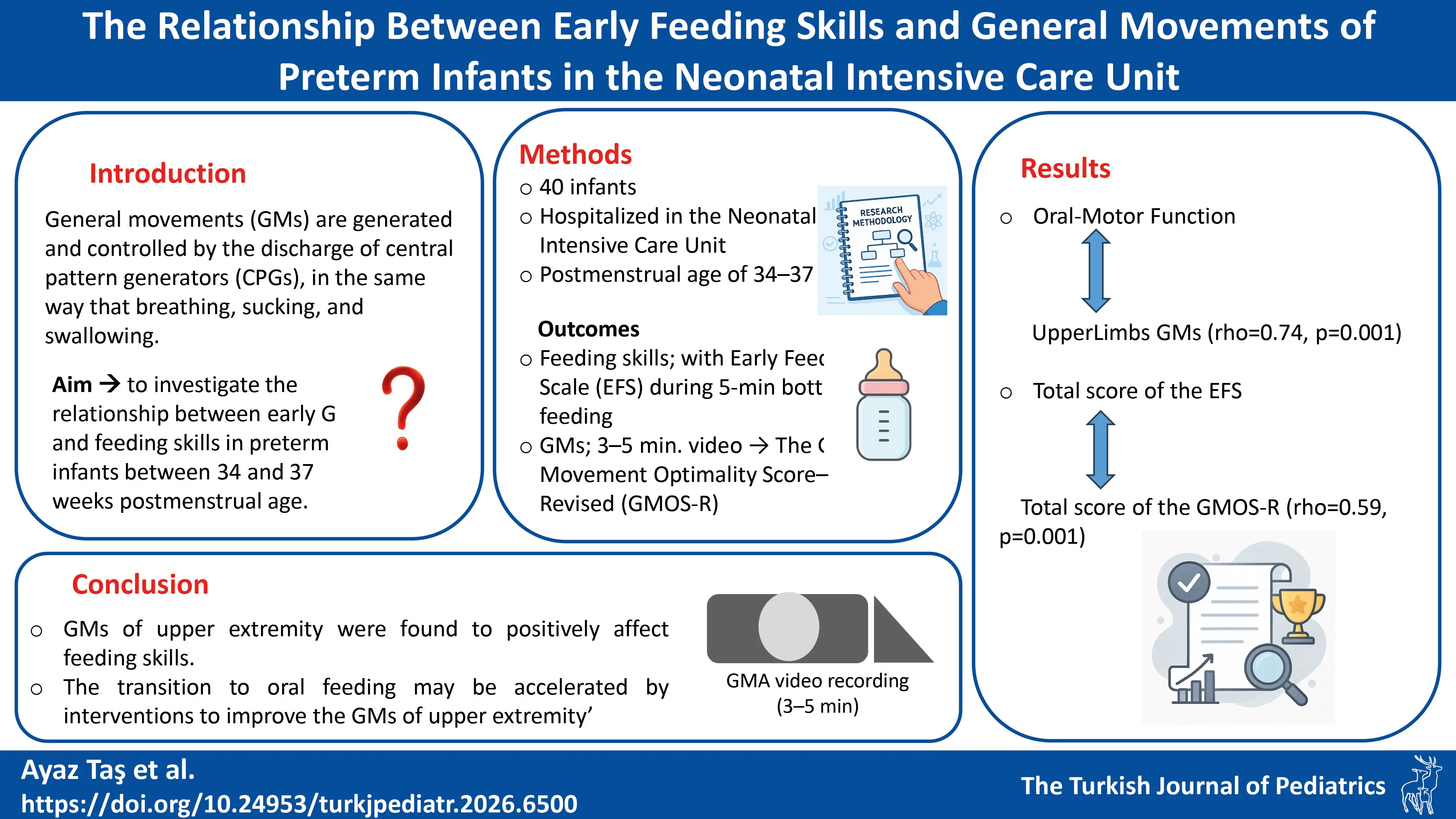
Results. A strong correlation was found between the Oral-Motor Function subscale of the Early Feeding Skills Assessment Tool and the Upper Limbs subscale of the General Movements Motor Optimality Score (rho=0.74, p=0.001). Among the demographic characteristics, only maternal age was associated with feeding skills. A weak correlation was determined between the Physiologic Stability subscale of the Early Feeding Skills Assessment Tool and maternal age (rho=0.34 p=0.03).
Conclusions. This study reveals the relationship between feeding skills and general movement of preterm infants at NICU. GMs of upper extremity were found to positively affect feeding skills. This process may be accelerated by interventions to improve the GMs of upper extremity during the transition to oral feeding.
Keywords: infant, movement, premature, upper extremity
Introduction
Preterm infants face substantial feeding challenges as a result of the immaturity of their oral–motor, neurological, and gastrointestinal systems. Approximately 80% experience oral feeding difficulties during their hospitalization in the neonatal intensive care unit (NICU).1 Such difficulties not only delay hospital discharge, but may also adversely affect growth trajectories and neurodevelopment if not promptly identified and addressed. Moderate and late preterm infants generally present with less severe medical complications than those born very preterm; however, they still face a greater risk of adverse neurodevelopmental outcomes when compared with term infants.2 Late preterm infants also show a high prevalence of feeding problems due to factors such as immature brain development, incoordination of the suck-swallow-breathing, lower oromotor tone, gastrointestinal dysmotility, immature suction pressure, higher incidence of gastroesophageal reflux and disturbed sleep–wake cycles. These issues often lead to several problems: hypoglycemia, hyperbilirubinemia, prolonged nasogastric tube feeding, delayed achievement of oral feeding independence, and reduced breastfeeding rates.3-5 These infants are also at risk for hypothermia, respiratory morbidities, infection, intraventricular hemorrhage (IVH), and periventricular leukomalacia (PVL).4 This population is often affected by incomplete coordination of suck–swallow–breathe, which may be further disrupted by comorbidities such as gastroesophageal reflux, necrotizing enterocolitis (NEC), or respiratory instability.1,6
The acquisition of feeding skills is a complex process that requires the coordination of three actions: sucking, swallowing and breathing.7 Additionally, the coordination of multiple sensory-motor systems is necessary to avoid serious adverse effects such as coughing, gagging, apnea, bradycardia, hypoxia, tachypnea, increased energy expenditure, and aspiration.8-10 The development of the coordination among these three actions in preterm infants is a dynamic process and typically does not begin until the postmenstrual age (PMA) of 32 to 34 weeks.11 Feeding is one of the first coordinated motor skills an infant requires;12 therefore, difficulties in this area are considered an early marker of brain changes associated with atypical motor and neurological development.13-15 Sucking ability may seem “natural” for healthy term infants, but this is not the case for premature infants.16 Moreover, achieving independence in oral feeding is challenging, as it requires the integration of the lips, jaw, cheeks, tongue, palate, pharynx, and larynx to establish coordinated sucking, breathing, and swallowing.17 In preterm infants, it is common to see disruptions in the coordination of these actions, as well as abnormal feeding behaviors such as atypical jaw or tongue movements, leading to inadequate nutrition.18 Early sucking and feeding skills predict infant neurodevelopmental outcome.19 In addition, preterm infants with feeding difficulties have been reported to be at risk for delayed cognitive and language development in long-term follow-up.20
Feeding and swallowing of the upper gastrointestinal tract and are controlled by specific brain regions and cranial nerves. The coordination of these movements is regulated by central pattern generators (CPGs). These neuronal networks, typically located in the spinal cord or brainstem, autonomously coordinate the activity of multiple muscles into movement series without requiring segmental sensory or supraspinal input.21
General movements (GMs) are generated and controlled by the discharge of CPGs, in the same way that breathing, sucking, and swallowing are.22,23 Prechtl’s General Movements Analysis is a widely used predictive tool, whose assessments are based on visual perception of age-specific normal or abnormal spontaneous GMs.24 This assessment method is considered a highly sensitive and reliable tool for evaluating the immature nervous system.25 The three main chronological periods of GMs are known as ‘Preterm’ (up to about 36 weeks of gestational age), ‘Writhing’ (up to about 8 weeks of postterm age) and, ‘Fidgety’ movements (9 to about 20 weeks of postterm age).26 In both preterm and term periods, GMs are defined as variable, whole-body movements characterized by a fluid sequence of arm, leg, neck, and trunk motions. Throughout this period, GMs emerge and disappear with varying intensity, speed, and range of motion.24 Reduced variation and diversity in GMs are strongly associated with cerebral palsy, a condition that originates from CPGs located in the spinal cord and brainstem.22,23,27
To the best of our knowledge, no study has evaluated the relationship between preterm infants’ feeding skills and their GMs during the writhing period, which are considered the earliest spontaneous movements. However, one study, Nieuwenhuis et al., reported that the development of sucking patterns in preterm infants during the fidgety period depends on the quality of fidgety movements themselves. Uncoordinated sucking patterns were associated with abnormal fidgety movements, suggesting that uncoordinated sucking, swallowing, and breathing may indicate underlying neurological dysfunction.28 In the light of this important discovery, this study aimed to investigate the relationship between early GMs, and feeding skills in preterm infants between 34 and 37 weeks PMA.
Materials and Methods
This cross-sectional study included 40 preterm infants with a PMA of 34–37 weeks who were hospitalized in the Neonatal Intensive Care Unit of Abant İzzet Baysal University Training and Research Hospital between November 2022 and December 2024. Ethical approval was given by the Clinical Research Ethics Committee of Bolu Abant İzzet Baysal University (approval number: 2022/266, approval date: 25.10.2022). Informed consent was obtained from the parents of all participating infants. The three data sources were demographic information (birth weight, gestational age, date of birth, age, and sex), feeding skills measured using the Early Feeding Skills Assessment Tool (EFS), and GMs, evaluated using the General Movement Assessment.
Participants
Samples of preterm infants who admitted to the Neonatal Intensive Care Unit of Abant İzzet Baysal University Training and Research Hospital and fulfilled the inclusion criteria were recruited through continuous convenience sampling. There were 40 infants who had a postmenstrual age of 34-37 weeks in this study following the acquisition of written informed consent from their parents. Requirements for inclusion were as follows: postmenstrual age of between 34 and 37 weeks, no requirement for ventilation assistance, a history of preterm birth, and the capacity to engage in oral feeding. Infants were excluded if they had congenital malformations, genetic disorders, or metabolic diseases.
Measurements
Assessments were conducted in a quiet environment where the average noise level did not exceed 45 dB. Records were made of the infants’ gestational age, birth weight, corrected age, and sex. The following information was also documented: time to transition to oral feeding, hospitalization duration and the presence of morbidities such as intracranial hemorrhage (ICH), PVL, congenital malformation, respiratory distress syndrome, sepsis, hypoglycemia, hyperbilirubinemia, patent ductus arteriosus (PDA), and NEC.
Early feeding skills assessment tool
The feeding skills of all infants were assessed using the EFS by one researcher (S.A.T.) during a 5-minute bottle-feeding session. A new bottle and a rubber bottle nipple were used for each newborn. These sessions were conducted at least two hours after the previous feeding. During feeding, infants were positioned in a 30-degree reclined supine angle in the arms of the nurse.29 It is a valid and reliable tool for assessing feeding skills in preterm infants, based on the observation of feeding behavior.30 The Turkish version consists of 19 items across five subscales: breathing regulation, oral-motor function, swallowing coordination, feeding engagement, and physiological stability. Each item is rated using a three-point Likert scale, with specific response options for each item. The ranges for the subscales are as follows: breathing regulation subscale, 5-15 points, oral-motor function subscale 4-12 points, swallowing coordination subscale, 4-12 points, feeding engagement subscale, 2-6 points and physiological stability subscale, 4-12 points. The total EFS score ranges from 19 to 57, with higher scores indicating more mature feeding skills. Turkish version of the EFS has a high test-retest reliability with an ICC of 0.95.31
General movements assesment
In general, general movements (GMs) maintain a similar appearance from the early fetal period until the second month of term age. From term age onward, these movements are referred to as “writhing movements.” At 6–9 weeks post-term age, these movements are gradually replaced by fidgety GMs. Spontaneous movements in infants were assessed observationally using the General Movements Assessment (GMA), developed by Prechtl. This involved making short (three- to five-minute) video recordings of each infant, which were used by a GM Trust-certified evaluator (S.A.T.) to calculate the General Movement Optimality Score–Revised (GMOS-R).26
This detailed assessment employs a semi-quantitative approach using a standardized scale to detect minimal changes in movement quality. A score was assigned to each movement criterion, such as amplitude, speed, range in space, initiation, and termination of GMs.
The General Movement Optimality Score–Revised (GMOS-R) ranges from 0 to 38, with higher scores indicating better movement quality. The scoring is distributed as follows: Upper extremities 0–16 points, lower extremities 0–16 points, neck and trunk 0–4 points, sequencing 0–2 points.32,33
Statistical analysis
The sample size was calculated using the G*Power 3.1.9.2 software. Post hoc analysis was performed with a correlation coefficient of 0.59 between the total scores of the EFS and the General Movements Motor Optimality Score, an alpha level of 0.05, and a total sample size of 40. These parameters resulted in a study power of 0.98.
Statistical analysis was conducted using the SPSS (Statistical Package for Social Sciences) software (version 20.0). The Shapiro-Wilk test was used to assess the normality of data distribution. Descriptive statistics were presented as mean ± standard deviation and median (interquartile range, IQR) for continuous variables, and as numbers and frequencies for binary and categorical variables. Comparisons between two independent groups (presence vs. absence of respiratory distress syndrome or sepsis) were performed using the Mann-Whitney U test. Categorical variables were compared using Fisher’s exact test. The Spearman correlation test was performed to examine the relationship between the EFS and the General Movements Motor Optimality Score in preterm infants. The strength of correlation coefficients was classified as < 0.50 (weak correlation), 0.50-0.70 (moderate), or > 0.70 (strong).34 A p-value of <0.05 was considered statistically significant for all analyses.
Results
The study included preterm infants with a mean gestational age of 33.52±1.50 weeks, and for 30% of these the age was 34 weeks. ICH was detected in one case, located in the left ventricle, with a severity of Grade 3. Periventricular leukomalacia was observed in two cases, both bilateral, with a severity of Grade 1. The mean duration to achieve full oral feeding was 14.33±10.31 days, and the mean hospitalization duration was 19.90±16.15 days. The clinical characteristics of the preterm infants are summarized in Table I.
| LBW: low birth weight, SD: standard deviation. | |
| Table I. Clinical profile of preterm infants (N=40). | |
| Variables | |
| Maternal age, years, mean±SD |
|
| Mode of delivery, n (%) | |
| Cesarean Section |
|
| Vaginal birth |
|
| Sex, n (%) | |
| Female |
|
| Male |
|
| Gestational age, weeks, mean±SD |
|
| Gestational age categories, n (%) | |
| 30 weeks |
|
| 31 weeks |
|
| 32 weeks |
|
| 33 weeks |
|
| 34 weeks |
|
| 35 weeks |
|
| 36 weeks |
|
| Birth weight, grams, mean±SD |
|
| Birth weight categories, n (%) | |
| LBW (< 2500 gram) |
|
| Very LBW (< 1500 gram) |
|
| Extremely LBW (< 1000 gram) |
|
| Time to transition to oral feeding, days, mean±SD |
|
| Hospitalization duration, days, mean±SD |
|
| Periventricular leukomalacia, n (%) |
|
| Congenital malformation, n (%) |
|
| Respiratory distress syndrome, n (%) |
|
| Sepsis, n (%) |
|
| Hypoglycemia, n (%) |
|
| Hyperbilirubinemia, n (%) |
|
| Patent ductus arteriosus, n (%) |
|
| Necrotizing enterocolitis, n (%) |
|
The mean scores of Feeding Skills and General Movements Quality of Preterm Infants are presented in Table II. The EFS showed a mean score of 13.03±2.29 for the Respiratory Regulation subscale, 9.23±2.24 for Oral-Motor Function, 10.95±1.82 for Swallowing Coordination, 4.43±0.78 for Engagement, and 10.78±1.34 for Physiologic Stability. The total score for this assessment was 48.40±7.11. For the General Movements Motor Optimality Score, the mean scores for the four subscales were as follows: for the Upper Limbs, 15.60±2.58, for the Lower Limbs, 15.13±3.08, for Neck and Trunk, 3.15±0.83, and for the Sequence of General Movements, 1.70±0.46. The total score for this assessment was 35.65±6.04. In the global assessment, 31 infants (77.5%) were classified as having a Poor Repertoire, while 9 (22.5%) were classified as normal. Preterm infants without respiratory distress syndrome demonstrated significantly higher scores in oral-motor function (p=0.02), engagement (p=0.003), physiologic stability (p=0.007), and total score (p=0.01) compared to those with respiratory distress syndrome. Additionally, the upper limb subscale of the General Movements Motor Optimality Score was significantly higher in infants without respiratory distress (p=0.02) (Table II).
| *Mann–Whitney U test; the significance level was set at p<0.05; βFisher’s exact test; the significance level was set at p<0.05. Bold values indicate statistical significance. | |||||||
| Table II. Feeding skills and general movements quality of preterm infants, and their comparison between infants with and without respiratory distress syndrome and sepsis. | |||||||
| Variables |
(N=40) |
|
|
||||
|
|
|
|
|
|
|
||
|
|
|
||||||
| Early Feeding Skills Assessment Tool | |||||||
| Respiratory regulation |
|
|
|
|
|
|
|
| Oral-motor function |
|
|
|
|
|
|
|
| Swallowing coordination |
|
|
|
|
|
|
|
| Engagement |
|
|
|
|
|
|
|
| Physiologic stability |
|
|
|
|
|
|
|
| Total |
|
|
|
|
|
|
|
| General Movements Motor Optimality Score | |||||||
| Upper limbs |
|
|
|
|
|
|
|
| Lower limbs |
|
|
|
|
|
|
|
| Neck and trunk |
|
|
|
|
|
|
|
| Sequence of general movements |
|
|
|
|
|
|
|
| Total |
|
|
|
|
|
|
|
| Global assessment, n (%) | |||||||
| Poor repertoire |
|
|
|
|
|
|
|
| Normal |
|
|
|
|
|
||
Weak, moderate, and strong correlations were observed between the subscales of the EFS and the General Movements Motor Optimality Score (rho=0.34 to 0.74, p<0.05) (Table III). The lowest correlation was between the Physiologic Stability subscale of the EFS and the Neck and Trunk subscale of the General Movements Motor Optimality Score (rho=0.34, p=0.02). The highest correlation was observed between the Oral-Motor Function subscale of the EFS and the Upper Limbs subscale of the General Movements Motor Optimality Score (rho=0.74, p=0.001). A moderate correlation was found between the total score of the EFS and the total score of the General Movements Motor Optimality Score (rho=0.59, p=0.001).
| Data was expressed as rho (p); Spearman correlation test: the significance level was set as *p<0.05 and **p<0.01. | |||||||
| Table III. The relationship between the early feeding skills assessment tool and the general movements motor optimality score in preterm infants (N=40). | |||||||
| Variables |
|
||||||
|
|
|
|
|
|
|
||
| General Movements Motor Optimality Score | Upper limbs |
|
|
|
|
|
|
|
|
|
|
|
|
|
||
| Lower limbs |
|
|
|
|
|
|
|
|
|
|
|
|
|
|
||
| Neck and trunk |
|
|
|
|
|
|
|
|
|
|
|
|
|
|
||
| Sequence of general movements |
|
|
|
|
|
|
|
|
|
|
|
|
|
|
||
| Total score |
|
|
|
|
|
|
|
|
|
|
|
|
|
|
||
Correlation analyses showed several significant associations between the EFS and clinical variables in preterm infants (Table IV). Maternal age showed a weak positive correlation with Physiologic Stability (rho=0.34, p=0.03). Time to transition to oral feeding demonstrated significant negative correlations with all subscales, including Respiratory Regulation (rho=–0.43, p=0.005), Oral-Motor Function (rho=–0.52, p=0.001), Swallowing Coordination (rho=–0.49, p=0.003), Engagement (rho=–0.46, p=0.003), Physiologic Stability (rho=–0.54, p=0.001), and the total score (rho=–0.58, p=0.001). Similarly, length of hospital stay was strongly and negatively correlated with all subscales and the total score (rho range=–0.54 to –0.70, all p=0.001) (Table IV).
| Data was expressed as rho (p); Spearman correlation test: the significance level was set as *p<0.05 and **p<0.01. | ||||||
| Table IV. Correlation values of the early feeding skills assessment tool regarding the maternal age, gestational age, and birth weight, time to transition to oral feeding, length of hospital stay in preterm infants (N=40). | ||||||
| Variables |
|
|||||
|
|
|
|
|
|
|
|
| Maternal age |
|
|
|
|
|
|
|
|
|
|
|
|
|
|
| Gestational age |
|
|
|
|
|
|
|
|
|
|
|
|
|
|
| Birth weight |
|
|
|
|
|
|
|
|
|
|
|
|
|
|
| Time to transition to oral feeding |
|
|
|
|
|
|
|
|
|
|
|
|
|
|
| Length of hospital stay |
|
|
|
|
|
|
|
|
|
|
|
|
|
|
Correlation analyses revealed several significant associations between the General Movements Motor Optimality Score and clinical variables in preterm infants (Table V). Maternal age was positively correlated with Neck and Trunk scores (rho=0.40, p=0.009). Gestational age showed a positive correlation with the Sequence of General Movements (rho=0.35, p=0.02). Time to transition to oral feeding was negatively correlated with Upper Limbs (rho=–0.40, p=0.01), Lower Limbs (rho=–0.51, p=0.001), Total Score (rho=–0.43, p=0.005), and Global Assessment (rho=–0.34, p=0.02). Similarly, length of hospital stay demonstrated negative correlations with Upper Limbs (rho=–0.40, p=0.009), Lower Limbs (rho=–0.53, p=0.001), Total Score (rho=–0.43, p=0.005), and Global Assessment (rho=–0.33, p=0.03) (Table V).
| Data was expressed as rho (p); Spearman correlation test: the significance level was set as *p<0.05 and **p<0.01. | ||||||
| Table V. Correlation values of the general movements motor optimality score regarding the maternal age, gestational age, birth weight, time to transition to oral feeding, length of hospital stay in preterm infants (N=40). | ||||||
| Variables |
|
|||||
|
|
|
|
|
|
|
|
| Maternal age |
|
|
|
|
|
|
|
|
|
|
|
|
|
|
| Gestational age |
|
|
|
|
|
|
|
|
|
|
|
|
|
|
| Birth weight |
|
|
|
|
|
|
|
|
|
|
|
|
|
|
| Time to transition to oral feeding |
|
|
|
|
|
|
|
|
|
|
|
|
|
|
| Length of hospital stay |
|
|
|
|
|
|
|
|
|
|
|
|
|
|
Discussion
This study included preterm infants transitioning to oral feeding. A strong positive correlation was found between oral motor function and upper extremity GMs; in other words, the better the general movements of the upper extremities, the better the feeding skills. Better feeding skills are more likely to lead to the development of independent feeding skills in the future. This finding suggests that rehabilitation interventions aimed at developing preterm infants’ oral feeding, and generally improving their overall feeding skills should target upper extremity GMs. Additionally, it is known that GMs are directly linked to development of feeding skill and play a crucial role in early feeding skills. Therefore, the most effective interventions for preterm infants are those that take a holistic approach even as they look at their overall development and assisting in all functional areas.
The American Academy of Pediatrics (AAP) emphasizes that competence in oral feeding is a requirement for discharge from the NICUs.35 Before transitioning to oral feeding, preterm infants should be fed by tube to ensure sufficient nutrient intake. This is an important process, as it directly affects weight gain, and has a significant impact on long-term neurodevelopmental outcomes.36 In the United States, the prevalence of pediatric feeding disorders fluctuates form 2.7% and 4.3%, with more than 50% of cases occurring in preterm infants.37 Getting to know that, preterm infants frequently show a feeding problems and require proper care. In order to manage oral feeding difficulties and minimize their effects, it is important to execute an evaluation during hospitalization, intervention as early as possible and ensure active management.38 There’s no clear direction for the timing of oral feeding starts. A few studies suggest to start oral feeding before 33 week while others suggest a later time39 The current study focused on infants who started oral feeding between 34 and 37 weeks PMA, because those with more mature oral feeding skills have shown to feed a higher feeding volumes.29 Ecevit et al. assessed oral feeding skills with NeoSAFE and reported that feeding skills were similar in late preterm, early-term, and full-term infants. Late preterm infants appear to similar oral motor abilities with their term counterparts.29
There is still debate in the literature on the influence of gestational age, birth weight, and postmenstrual age on the initiation of oral feeding, sucking ability, and overall feeding process. Some researchers determine that these demographic factors have a significant impact on feeding development, while others disagree.40,41 This discrepancy may be due to differences in the age ranges of infants across studies. Our study focused on preterm infants at age of PMA 34–37 weeks, and found no significant impact on early feeding skills for maternal age, gestational age, or birth weight. In contrast, the factor of maternal age was observed to influence physiological stability during feeding. It is important to remember that the transition to oral feeding is influenced by a range of other factors, including continuous positive airway pressure support, mechanical ventilation, and neonatal morbidities including bronchopulmonary dysplasia, NEC, and IVH.42
The EFS has been shown to be a valid and reliable instrument for evaluating oral feeding skills and readiness for oral feeding transition in preterm infants. Girgin et al. used the scale with preterm infants with similar demographic characteristics to the ones in the present study (gestational age, postmenstrual age, and birth weight) and found similar EFS scores.31
In the moderate to late preterm population, adequate follow-up is often lacking, which limits the understanding of potential long-term effects on neurodevelopment.43 Regular monitoring becomes particularly important when there are frequent poor repertoire patterns in GMs, as these abnormal patterns are often associated with a wide range of neurodevelopmental alterations.44 Compared with previous studies, the present study identified a higher proportion of poor repertoire (PR) patterns among moderate to late preterm infants.45 This discrepancy may be attributable to differences in NICU care conditions. The global evidence suggests that there are considerable variations in prenatal, perinatal, and postnatal care practices across countries. Unfortunately, these variations may substantially influence neurodevelopmental outcomes in infants at high risk for neurodevelopmental impairments. Therefore, to reduce this inequality, it is important to improve the quality of neonatal intensive care. Such improvements, as well as earlier detection of cerebral palsy and the systematic implementation of early intervention strategies, are likely to a reduce the prevalence of cerebral palsy and improve long-term neurodevelopmental trajectories in this vulnerable population.46
In the first months after birth, both sucking patterns and GMs may serve as early indicators of future neurological impairments. However, inconsistent results have been reported across studies on the relationship between these two factors during the fidgety period. Yardımcı Lokmanoğlu et al., examining the relationship between sucking patterns and fidgety movements, reported only a weak correlation between sucking and the Motor Optimality Score-Revised total score, fidgety movements, observed movement patterns, and age-adequate movement repertoire subcategories.47 On the other hand, Nieuwenhuis et al. reported a clear association between normal and abnormal sucking patterns in preterm infants and the quality of fidgety movements. Other studies also found such an interconnection, including the regulation or generation of fidgety movements. Additionally, the coordination of these motor activities was found to be highly dependent on CPGs, as evidenced by their association with other subcategories of the Motor Optimality Score (MOS).28 These findings are further supported by the present study, which shed light on the relationship between feeding skills and general movements during the writhing period. This finding provides evidence for the argument that motor and oral motor skills positively influence each other’s development, and highlights the interconnected nature of early neuromuscular control in preterm infants.48 At the age of 2, children with definite feeding difficulties and those at risk for feeding difficulties had generally lower cognitive, language, and motor scores.49 These feeding difficulties may be due to early hypotonia, which may disrupt the development of oral-motor skills.50 Early feeding behaviors are significant predictors of motor outcomes at ages 4-5. Therefore, it is important to identify extremely preterm infants with early feeding difficulties due to the risk of poor motor outcomes in later childhood. This highlights the need for screening for early diagnosis and intervention.51
It is important to note that wide variations in hospital practices contribute to differences in the levels of care provided to late preterm infants.52 Aliaga et al. revealed that these differences in care practices influence both the duration of birth hospitalization and the risk of readmission.53 These findings underscore the importance of standardizing care for late preterm infants across clinical settings to reduce variability in outcomes and minimize readmission rates. Furthermore, such standardization would facilitate consistency in outcome measurement and enhance the reliability of assessments in future research.52
In preterm infants, delays in discharge, which manifested as prolonged hospitalization and higher postmenstrual age at discharge, were likewise associated with poorer feeding performance at term-equivalent age.54 Assessment of oral feeding levels in late preterm infants during their first feeding may help identify those at risk for difficulties that could delay hospital discharge. Lau et al. demonstrated that such difficulties in this age group not only influence the length of hospital stay, but also increase the likelihood of readmissions, further reporting that feeding skills are a significant predictor of hospitalization duration.55 Similarly, Crowe et al. highlighted that feeding difficulties negatively impact the achievement of full oral feeding and prolong hospitalization.56 Correspondingly, the present study revealed that feeding skills were associated with the duration of both hospitalization and transition to oral feeding. Furthermore, GMs were also found to be related to these outcomes. Taken together, these results suggest that the quality of both feeding skills and GMs may play a protective role, by shortening hospital stay and accelerating the transition. From a clinical perspective, these findings highlight the importance of systematically assessing both oral feeding performance and general movement quality in preterm infants during hospitalization. Early identification of impairments in these domains may guide the implementation of targeted, evidence-based interventions. The aim of these should be to support neurodevelopmental progress, optimize feeding readiness, and ultimately improve discharge outcomes and reduce healthcare burden.
It is known that early medical factors in preterm infants are linked to feeding performance at term-equivalent age.54 In particular, GM trajectories during the NICU stay have been shown to be negatively influenced by presence of ICH, younger gestational age, the requirement for respiratory support, patent ductus arteriosus, and the presence of infection.57 In line with the literature, this study found that better GMs were associated with higher maternal age, gestational age and birth weight. This study has the potential to assist health care professionals in the early identification of infants with morbidities who are at increased risk of adverse developmental trajectories, even prior to hospital discharge. Preterm infants at term equivalent age have lower feeding skill scores and greater difficulty with arousal, tongue positioning, suck-swallow-breathe discoordination, and completing feedings.58 In these circumstances, careful monitoring of additional morbidities may provide a practical means of tracking neurodevelopmental risk and guiding timely referral to appropriate early intervention services.
Our study is notable as the first to reveal the relationship between early feeding skills and writhing movements, among the earliest general movement repertoires in life. Unlike previous studies, which examined the relationship between sucking patterns and fidgety movements in infants with a corrected age of 9-16 weeks.28,47 our study focused on preterm infants at the age of 34-37 weeks PMA. This sample is an important age group, however, we acknowledge that this limited age range makes it difficult to generalize the results to all preterm age infants. An important contribution of this study is highlighting the role of morbidities in preterm infants in the NICU, and demonstrating the interrelationships between length of hospital stay, time to transition to oral feeding, GMs, and feeding skills. Early-life stress is another factor that negatively impacts oral feeding skills and their development,59,60 however, the scope of this study did not include accounting for stress responses when deciding on feeding times. The study sample is relatively small and heterogeneous in terms of gestational age, and the number of very preterm infants is also small. Differences in the development of early feeding skills among very preterm infants are well documented, therefore, this heterogeneity limits the generalizability of the findings.61 Indeed, infants born at the earliest gestational ages are at the most significant risk for adverse outcomes during the neonatal period. Gestational age is a key determinant of both neonatal survival and morbidity.62 Feeding performance in very preterm infants is often delayed and inconsistent due to immature neural and oro-motor structures. Even at 40 weeks PMA, compared with term infants, preterm infants exhibit significantly less mature feeding behaviors, including more frequent nasogastric feeding, longer feeding durations, and increased episodes of coughing, choking, and fussing during feeding.54,63,64 PMA at the time of assessment is critical, as feeding skills and GMs mature progressively with increasing PMA, and earlier assessments may underestimate eventual abilities.54,63 In addition, even when at term age, preterm infants continue to demonstrate more problems than their term infant counterparts, including poor arousal, poor tongue positioning, suck-swallow-breathe discoordination, inadequate sucking bursts, tonal abnormalities, tongue discoordination during sucking, and difficulty in regulating breathing.55 From this perspective, it is recommended that preterm infants be followed longitudinally, including at term age, and evaluated within a broad developmental framework.58
One of the limitations of our study is the lack of a healthy term infant control group for comparison with preterm infants in the GMs and feeding skills. Such a comparison could yield a more precise understanding of the specific effects of prematurity on feeding skills and motor development.
In conclusion, this study highlights the importance of GMs in the feeding performance of premature infants. GMs, especially upper extremity GMs are associated with feeding skills. A comprehensive evaluation of premature infants in this regard is critical. This evaluation should include their GMs, in addition to assessing feeding disorders, which are among the most common causes of morbidity in preterm infants in NICU. This approach enables healthcare professionals to adopt a more in-depth, multidimensional perspective in the evaluation and treatment of these infants. For such infants, we hypothesize that effective, evidence-based interventions to improve oral feeding skills can to shorten hospitalization and reduce the risk of hospital readmission.
Ethical approval
The study was approved by Clinical Research Ethics Committee of Bolu Abant İzzet Baysal University (date: October 25, 2022, number: 2022/266).
Source of funding
The authors declare the study received no funding.
Conflict of interest
The authors declare that there is no conflict of interest.
References
- Anuk Ince D, Takci S, Kilicdag H, Turan O. Editorial: feeding difficulties in newborn infants and new approaches in practice. Front Pediatr 2024; 12: 1462493. https://doi.org/10.3389/fped.2024.1462493
- Song IG. Neurodevelopmental outcomes of preterm infants. Clin Exp Pediatr 2023; 66: 281-287. https://doi.org/10.3345/cep.2022.00822
- Vizzari G, Morniroli D, D’Auria A, et al. Feeding difficulties in late preterm infants and their impact on maternal mental health and the mother-infant relationship: a literature review. Nutrients 2023; 15: 2180. https://doi.org/10.3390/nu15092180
- Sharma D, Padmavathi IV, Tabatabaii SA, Farahbakhsh N. Late preterm: a new high risk group in neonatology. J Matern Fetal Neonatal Med 2021; 34: 2717-2730. https://doi.org/10.1080/14767058.2019.1670796
- Huff K, Rose RS, Engle WA. Late preterm infants: morbidities, mortality, and management recommendations. Pediatr Clin North Am 2019; 66: 387-402. https://doi.org/10.1016/j.pcl.2018.12.008
- Bala FE, McGrattan KE, Valentine CJ, Jadcherla SR. A narrative review of strategies to optimize nutrition, feeding, and growth among preterm-born infants: implications for practice. Adv Nutr 2024; 15: 100305. https://doi.org/10.1016/j.advnut.2024.100305
- Lau C. Development of suck and swallow mechanisms in infants. Ann Nutr Metab 2015; 66(Suppl 5): 7-14. https://doi.org/10.1159/000381361
- Fucile S, Caulfield A, Geleynse S. Oral feeding in preterm infants: a conceptual model for health care practitioners. Neonatal Netw 2019; 38: 348-356. https://doi.org/10.1891/0730-0832.38.6.348
- Azuma D, Maron JL. Individualizing oral feeding assessment and therapies in the newborn. Res Rep Neonatol 2020; 23-30. https://doi.org/10.2147/RRN.S223472
- Fry TJ, Marfurt S, Wengier S. Systematic review of quality improvement initiatives related to cue-based feeding in preterm infants. Nurs Womens Health 2018; 22: 401-410. https://doi.org/10.1016/j.nwh.2018.07.006
- Osman AA, Ahmed ES, Hassanein FES, Mohamed HS, Brandon D. Assessment of oral feeding readiness among preterm infants. ASNJ 2017; 5: 116-121. https://doi.org/10.21608/asnj.2017.58472
- Amaizu N, Shulman R, Schanler R, Lau C. Maturation of oral feeding skills in preterm infants. Acta Paediatr 2008; 97: 61-67. https://doi.org/10.1111/j.1651-2227.2007.00548.x
- Medoff-Cooper B, Shults J, Kaplan J. Sucking behavior of preterm neonates as a predictor of developmental outcomes. J Dev Behav Pediatr 2009; 30: 16-22. https://doi.org/10.1097/DBP.0b013e318196b0a8
- Wolthuis-Stigter MI, Luinge MR, da Costa SP, Krijnen WP, van der Schans CP, Bos AF. The association between sucking behavior in preterm infants and neurodevelopmental outcomes at 2 years of age. J Pediatr 2015; 166: 26-30. https://doi.org/10.1016/j.jpeds.2014.09.007
- Wolthuis-Stigter MI, Da Costa SP, Bos AF, Krijnen WP, Van Der Schans CP, Luinge MR. Sucking behaviour in infants born preterm and developmental outcomes at primary school age. Dev Med Child Neurol 2017; 59: 871-877. https://doi.org/10.1111/dmcn.13438
- Jasani B, Patole S. Standardized feeding regimen for reducing necrotizing enterocolitis in preterm infants: an updated systematic review. J Perinatol 2017; 37: 827-833. https://doi.org/10.1038/jp.2017.37
- Samson N, Praud JP, Quenet B, Similowski T, Straus C. New insights into sucking, swallowing and breathing central generators: a complexity analysis of rhythmic motor behaviors. Neurosci Lett 2017; 638: 90-95. https://doi.org/10.1016/j.neulet.2016.12.016
- Törölä H, Lehtihalmes M, Yliherva A, Olsén P. Feeding skill milestones of preterm infants born with Extremely Low Birth Weight (ELBW). Infant Behav Dev 2012; 35: 187-194. https://doi.org/10.1016/j.infbeh.2012.01.005
- Slattery J, Morgan A, Douglas J. Early sucking and swallowing problems as predictors of neurodevelopmental outcome in children with neonatal brain injury: a systematic review. Dev Med Child Neurol 2012; 54: 796-806. https://doi.org/10.1111/j.1469-8749.2012.04318.x
- Dietrich LJ, Gong A, Gelfond J, Blanco CL. Oral feeding trajectories and neurodevelopmental outcomes at 12 and 24 month follow-up for preterm infants. J Neonatal Perinatal Med 2024; 17: 21-30. https://doi.org/10.3233/NPM-230088
- Hadders-Algra M. Early human motor development: from variation to the ability to vary and adapt. Neurosci Biobehav Rev 2018; 90: 411-427. https://doi.org/10.1016/j.neubiorev.2018.05.009
- Hadders-Algra M. Neural substrate and clinical significance of general movements: an update. Dev Med Child Neurol 2018; 60: 39-46. https://doi.org/10.1111/dmcn.13540
- Hafström M, Kjellmer I. Non-nutritive sucking in the healthy pre-term infant. Early Hum Dev 2000; 60: 13-24. https://doi.org/10.1016/s0378-3782(00)00091-8
- Ferrari F, Einspieler C, Hfr P, Bos AF, Cioni G. Prechtl’s method on the qualitative assessment of general movements in preterm, term and young infants. Mac Keith Press; 2004: 1-104
- Novak I, Morgan C, Adde L, et al. Early, accurate diagnosis and rarly intervention in cerebral palsy: advances in diagnosis and treatment. JAMA Pediatr 2017; 171: 897-907. https://doi.org/10.1001/jamapediatrics.2017.1689
- Einspieler C, Prechtl HFR. Prechtl’s assessment of general movements: a diagnostic tool for the functional assessment of the young nervous system. Ment Retard Dev Disabil Res Rev 2005; 11: 61-67. https://doi.org/10.1002/mrdd.20051
- Kinney HC. The near-term (late preterm) human brain and risk for periventricular leukomalacia: a review. Semin Perinatol 2006; 30: 81-88. https://doi.org/10.1053/j.semperi.2006.02.006
- Nieuwenhuis T, da Costa SP, Bilderbeek E, Geven WB, van der Schans CP, Bos AF. Uncoordinated sucking patterns in preterm infants are associated with abnormal general movements. J Pediatr 2012; 161: 792-798. https://doi.org/10.1016/j.jpeds.2012.04.032
- Ecevit A, Erdogan B, Anuk Ince D, et al. Determination of oral feeding skills in late preterm, early term, and full-term infants using the neonatal oral feeding monitor (NeoSAFE). Ital J Pediatr 2025; 51: 38. https://doi.org/10.1186/s13052-025-01867-2
- Thoyre SM, Shaker CS, Pridham KF. The early feeding skills assessment for preterm infants. Neonatal Netw 2005; 24: 7-16. https://doi.org/10.1891/0730-0832.24.3.7
- Aykanat Girgin B, Gözen D, Uslubaş R, Bilgin L. The evaluation of oral feeding in preterm infants: Turkish validation of the early feeding skills assessment tool. Turk Arch Pediatr 2021; 56: 440-446. https://doi.org/10.5152/TurkArchPediatr.2021.21008
- Einspieler C, Marschik PB, Pansy J, et al. The general movement optimality score: a detailed assessment of general movements during preterm and term age. Dev Med Child Neurol 2016; 58: 361-368. https://doi.org/10.1111/dmcn.12923
- Einspieler C, Bos AF, Spittle AJ, et al. The general movement optimality score-revised (GMOS-R) with socioeconomically stratified percentile ranks. J Clin Med 2024; 13: 2260. https://doi.org/10.3390/jcm13082260
- Mukaka MM. Statistics corner: a guide to appropriate use of correlation coefficient in medical research. Malawi Med J 2012; 24: 69-71.
- Stark AR, Adamkin DH, Batton DG, et al. Hospital discharge of the high-risk neonate. Pediatrics 2008; 122: 1119–1126. https://doi.org/10.1542/peds.2008-2174.
- Ehrenkranz RA, Dusick AM, Vohr BR, Wright LL, Wrage LA, Poole WK. Growth in the neonatal intensive care unit influences neurodevelopmental and growth outcomes of extremely low birth weight infants. Pediatrics 2006; 117: 1253-1261. https://doi.org/10.1542/peds.2005-1368
- Kovacic K, Rein LE, Szabo A, Kommareddy S, Bhagavatula P, Goday PS. Pediatric feeding disorder: a nationwide prevalence study. J Pediatr 2021; 228: 126-131.e3. https://doi.org/10.1016/j.jpeds.2020.07.047
- Fujitsuka M, Takao K, Ueki S, Morokuma S. Early introduction of oral feeding and its impact on full oral feeding and discharge in preterm infants: a systematic review protocol. JBI Evid Synth 2025; 23: 379-385. https://doi.org/10.11124/JBIES-24-00169
- Bakker L, Jackson B, Miles A. Oral-feeding guidelines for preterm neonates in the NICU: a scoping review. J Perinatol 2021; 41: 140-149. https://doi.org/10.1038/s41372-020-00887-6
- White-Traut R, Pham T, Rankin K, Norr K, Shapiro N, Yoder J. Exploring factors related to oral feeding progression in premature infants. Adv Neonatal Care 2013; 13: 288-294. https://doi.org/10.1097/ANC.0b013e31829d8c5a
- Lin YC, Chu CH, Chen YJ, Chen RB, Huang CC. Gestational age-related associations between early-life feeding trajectories and growth outcomes at term equivalent age in very preterm infants. Nutrients 2022; 14: 1032. https://doi.org/10.3390/nu14051032
- Muir H, Kidanemariam M, Fucile S. The impact of infant and maternal factors on oral feeding performance in premature infants. Phys Occup Ther Pediatr 2022; 42: 130-136. https://doi.org/10.1080/01942638.2021.1975863
- Chatziioannidis I, Kyriakidou M, Exadaktylou S, Antoniou E, Zafeiriou D, Nikolaidis N. Neurological outcome at 6 and 12 months corrected age in hospitalised late preterm infants -a prospective study. Eur J Paediatr Neurol 2018; 22: 602-609. https://doi.org/10.1016/j.ejpn.2018.02.013
- Nakajima Y, Einspieler C, Marschik PB, Bos AF, Prechtl HFR. Does a detailed assessment of poor repertoire general movements help to identify those infants who will develop normally? Early Hum Dev 2006; 82: 53-59. https://doi.org/10.1016/j.earlhumdev.2005.07.010
- Merino-Andrés J, Pérez-Nombela S, Hidalgo-Robles Á, Pérez-Domínguez MDP, Prieto-Sánchez L, Fernández-Rego FJ. The Relationship between general movements and risk factors in moderate-late preterm infants: a prospective cohort study. J Clin Med 2023; 12: 7763. https://doi.org/10.3390/jcm12247763
- Badawi N, Mcintyre S, Hunt RW. Perinatal care with a view to preventing cerebral palsy. Dev Med Child Neurol 2021; 63: 156-161. https://doi.org/10.1111/dmcn.14754
- Yardımcı-Lokmanoğlu BN, Demir N, Porsnok D, et al. Are sucking patterns and early spontaneous movements related to later developmental functioning outcomes? A cohort study. Eur J Pediatr 2024; 183: 1435-1446. https://doi.org/10.1007/s00431-024-05422-9
- Telles MS, Macedo CS. Relationship between the motor development of the body and the acquisition of oral skills. Pro Fono 2008; 20: 117-122. https://doi.org/10.1590/s0104-56872008000200008
- Crapnell TL, Woodward LJ, Rogers CE, Inder TE, Pineda RG. Neurodevelopmental profile, growth, and psychosocial environment of preterm infants with difficult feeding behavior at age 2 years. J Pediatr 2015; 167: 1347-1353. https://doi.org/10.1016/j.jpeds.2015.09.022
- Crapnell TL, Rogers CE, Neil JJ, Inder TE, Woodward LJ, Pineda RG. Factors associated with feeding difficulties in the very preterm infant. Acta Paediatr 2013; 102: e539-e545. https://doi.org/10.1111/apa.12393
- Rinat S, Mackay M, Synnes A, Holsti L, Zwicker JG. Early feeding behaviours of extremely preterm infants predict neurodevelopmental outcomes. Early Hum Dev 2022; 173: 105647. https://doi.org/10.1016/j.earlhumdev.2022.105647
- Joyner JA, Papermaster AE, Champion JD. Characteristics of late preterm infant readmissions: a systematic review. J Am Assoc Nurse Pract 2024; 36: 329-333. https://doi.org/10.1097/JXX.0000000000000986
- Aliaga S, Boggess K, Ivester TS, Price WA. Influence of neonatal practice variation on outcomes of late preterm birth. Am J Perinatol 2014; 31: 659-666. https://doi.org/10.1055/s-0033-1356484
- Ibrahim C, Grabill M, Smith J, Pineda R. Relationships between preterm medical factors and feeding behaviors at term-equivalent age. Early Hum Dev 2024; 191: 105975. https://doi.org/10.1016/j.earlhumdev.2024.105975
- Lau C, Bhat K, Potak D, Schanler RJ. Oral feeding assessment predicts length of hospital stay in late preterm infants. J Pediatr Mother Care 2015; 1: 102.
- Crowe L, Chang A, Wallace K. Instruments for assessing readiness to commence suck feeds in preterm infants: effects on time to establish full oral feeding and duration of hospitalisation. Cochrane Database Syst Rev 2016; 2016: CD005586. https://doi.org/10.1002/14651858.CD005586.pub3
- Mendonça KTD, Pascoal AFDS, Lanza FDC, Viñolas Prat B, Morais RLDS, Camargos ACR. Clinical factors related to abnormal general movements trajectories: development of a multicriteria index. Pediatr Phys Ther 2024; 36: 440-447. https://doi.org/10.1097/PEP.0000000000001129
- Pineda R, Prince D, Reynolds J, Grabill M, Smith J. Preterm infant feeding performance at term equivalent age differs from that of full-term infants. J Perinatol 2020; 40: 646-654. https://doi.org/10.1038/s41372-020-0616-2
- Griffith T, White-Traut R, Tell D, Green SJ, Janusek L. Epigenetics embedding of oral feeding skill development in preterm infants: a study protocol. Adv Neonatal Care 2024; 24: E88-E95. https://doi.org/10.1097/ANC.0000000000001216
- Griffith T, Tell D, Green SJ, et al. Early life stress, DNA methylation of NR3C1 and HSD11B2 , and oral feeding skill development in preterm infants : a pilot study. Adv Neonatal Care 2025; 25: 6-17. https://doi.org/10.1097/ANC.0000000000001208
- Kamity R, Kapavarapu PK, Chandel A. Feeding problems and long-term outcomes in preterm Infants-A systematic approach to evaluation and management. Children (Basel) 2021; 8: 1158. https://doi.org/10.3390/children8121158
- Manuck TA, Rice MM, Bailit JL, et al. Preterm neonatal morbidity and mortality by gestational age: a contemporary cohort. Am J Obstet Gynecol 2016; 215: 103.e1-103.e14. https://doi.org/10.1016/j.ajog.2016.01.004
- Gupta G, Vijay Kumar KV., Anitha A, Ninan B. Feeding performance in preterm infants and full term infants at 40 weeks postmenstrual age. Journal of Nepal Paediatric Society 2016; 36: 136-140. https://doi.org/10.3126/jnps.v36i2.14621
- Wahyuni LK, Mangunatmadja I, Kaban RK, et al. Factors affecting oral feeding ability in Indonesian preterm infants. Pediatr Rep 2022; 14: 233-243. https://doi.org/10.3390/pediatric14020031
Copyright and license
Copyright © 2026 The Author(s). This is an open access article distributed under the Creative Commons Attribution License (CC BY), which permits unrestricted use, distribution, and reproduction in any medium or format, provided the original work is properly cited.