Abstract
Background. Sepsis causes significant morbidity and mortality in children worldwide, despite the development of standardized treatment guidelines, vaccination programs, and advanced techniques for organ support in intensive care. Early mortality prediction is crucial for optimizing care, targeting interventions according to risk, and ultimately reducing mortality. Several scoring systems are used to predict outcomes and mortality for pediatric patients with sepsis, but how they compare in terms of sensitivity and specificity is unclear. This study compares the Phoenix, Pediatric Sequential Organ Failure Assessment (pSOFA), and Pediatric Logistic Organ Dysfunction (PELOD)-2 scores in predicting mortality in children with clinical sepsis.
Method. This retrospective cohort study was conducted at Dr. Cipto Mangunkusumo General Hospital, Jakarta, from January to April 2018. The primary outcome was early pediatric intensive care unit mortality (within 7 days). All data were analyzed using STATA 17 and MedCal12. The area under the receiver operatinc characteristics (AUROC) curves of the Phoenix, pSOFA, and PELOD-2 scores were compared using DeLong’s test.
Results. A total of 69 patients were clinically diagnosed with sepsis and 26.1% died. ROC curve analysis showed that the AUROCs of pSOFA, Phoenix, and PELOD-2 for predicting mortality were 0.745, 0.741, and 0.682, respectively. At their respective cutoffs, the pSOFA, Phoenix, and PELOD-2 scores had sensitivities for mortality prediction of 72.2%, 83.3%, and 72.2%, respectively, and specificities of 64.7%, 62.75%, and 54.90%.
Conclusions. The pSOFA and Phoenix scores demonstrated better performance in predicting mortality in children with clinical sepsis than the PELOD-2 score. When selecting an appropriate scoring system, factors such as simplicity and local conditions must be considered to ensure optimal performance.
Keywords: Phoenix, Pediatric Logistic Organ Dysfunction-2, Pediatric Sequential Organ Failure Assessment, sepsis
Introduction
Sepsis is a major contributor to morbidity and mortality in children.1,2 Despite advances in pathophysiological understanding, hemodynamic monitoring, and resuscitation strategies, the incidence and mortality of pediatric sepsis remains high, and may even have increased in recent years.2,3 Based on the 2017 Global Burden of Disease Group data, sepsis incidence shows a biphasic pattern with peak incidences in children and the elderly.4 Approximately 25.2 million cases of sepsis occur in children each year, with 84.5% occurring in children younger than 5 years and approximately 3 million deaths.4,5 A global case fatality rate (CFR) of sepsis and septic shock in children was estimated in a 2019 systematic review and meta-analysis to be 24.7%, with CFR rates in developing countries higher than in developed countries (31.7% vs. 19.3%).6
The current definition of sepsis still refers to the sepsis-3 definition of life-threatening organ dysfunction caused by a dysregulated host immune response to infection. These criteria were developed from adult population data, and life-threatening organ dysfunction was assessed using the Sequential Organ Failure Assessment (SOFA) score.7,8 However, direct application to children is considered inappropriate due to differences in vital sign variability, immune function development and comorbid disease profiles, epidemiology and outcomes. Therefore, the Sepsis-3 definition cannot be adopted directly in children. Nevertheless, the Sepsis-3 definition formed the basis for the development of revised criteria for pediatric sepsis.8
Early and accurate recognition of pediatric sepsis is crucial for reducing mortality. Effective identification of sepsis in the pediatric population requires accurate criteria for the assessment of disease progression. Therefore, many scoring systems have been developed over time.2 Various scoring systems have been proposed to diagnose and stage pediatric sepsis after the release of the sepsis-3 definition such as the pediatric Sequential Organ Failure Assessment (pSOFA) score, the Pediatric Logistic Organ Dysfunction (PELOD / PELOD-2) score and the pediatric multiple organ dysfunction (pMODS) score.9,10 In Indonesia, the diagnosis of pediatric sepsis uses the PELOD-2 score to assess life-threatening organ dysfunction. This is outlined in the National Guidelines for Medical Services for the management of sepsis in children, which was published in 2021.11 In 2024, a decade after the release of the sepsis-3 definition, international criteria for pediatric sepsis were released based on international surveys, systematic reviews, analysis of 3 million children, and a modified Delphi consensus process, with organ dysfunction assessed using the Phoenix score. These sepsis criteria were developed from data on children in high- and middle-income countries.8
Scoring systems standardize the assessment of disease severity, risk of morbidity and mortality, and patients’ clinical status.12 Scoring systems are generally categorized into two groups: prognostic scores estimate the risk of death, and descriptive or outcome scores provide information on disease progression.2,12 In the context of prognostic scores, the following have been included: the prognostic stability index (PSI), the pediatric risk of mortality (PRISM), and the pediatric index of mortality (PIM). Meanwhile, the following descriptive scores have been included: the PELOD, the pMODS, and the pSOFA scores.2 Since the Phoenix score was introduced in 2024, it has been studied only to a limited extent, and challenges remain in its application and effectiveness.13 This study aims to compare the performance of PELOD-2, pSOFA, and Phoenix scores in predicting mortality in children with clinical sepsis.
Methods
We conducted a secondary analysis of data from children with clinical sepsis admitted to Dr. Cipto Mangunkusumo Hospital, Jakarta, from January to April 2018. The subjects were patients aged 1 month to 18 years with a diagnosis of clinical sepsis. Clinical sepsis was established based on suspected infection and clinical evidence of organ dysfunction. Suspicion of infection was established based on evidence of infection (signs, symptoms, and physical examination findings consistent with a focus of infection) and signs of an inflammatory response, according to the criteria of the 2005 International Pediatric Sepsis Consensus Conference. Organ dysfunction was suspected when at least one of the following was present: decreased consciousness (Glasgow Coma Scale (GCS) <11), cardiovascular dysfunction, or respiratory dysfunction. Patients with autoimmune disease, malignancy, trauma or postoperative conditions were excluded. Secondary data from the subjects were used to calculate the PELOD-2, pSOFA and Phoenix scores. All subjects were then followed during management while monitoring the primary outcome of early death within 7 days of treatment. The management of sepsis during the study followed the Surviving Sepsis Campaign 2012 guidelines. Ethical approval was obtained from Faculty of Medicine Universitas Indonesia Institutional Review Board (approval number 0046/UN.F1/ETIK/2018). No additional ethical approval was required for this secondary analysis, and all procedures were performed in accordance with institutional and federal ethical standards for human experimentation and the 1975 Declaration of Helsinki.
Statistical analysis was performed using STATA version 17. The Kolmogorov–Smirnov test was used to assess the normality of the data. Normally distributed continuous variables were presented as means ± standard deviations and compared using the independent samples t-test, while non-normally distributed variables were presented as medians (ranges) and compared using the Mann–Whitney U test. Categorical variables were expressed as frequencies and percentages and compared using the chi-square test or Fisher’s exact test, as appropriate.
Receiver operating characteristic (ROC) curves were constructed to evaluate the predictive performance of each score. The area under the receiver operating characteristics (AUROC) curves, sensitivity, specificity, positive predictive value (PPV), and negative predictive value (NPV) were calculated to assess diagnostic performance. Comparisons between AUROCs were performed using the DeLong test. The optimal cutoff value for each score was determined using the Youden index.
Post-hoc power analyses were performed to assess the statistical power for the observed differences in AUROCs and correlations. A p-value < 0.05 was considered statistically significant.
Results
A total of 69 pediatric patients with clinical sepsis were included in this study, with a mortality rate of 26.1%. The majority of the subjects were male (60.9%) and 68.1% of the patients received mechanical ventilation. The complete characteristics of the study subjects are presented in Table I.
|
Non-normally distributed data are presented as a median with a range, normally distributed data as mean ± SD, and categorical data as n (%). PELOD-2, Pediatric Logistic Organ Dysfunction-2; pSOFA, pediatric Sequential Organ failure Assessment; SD, standard deviation. |
||||
| Table I. Characteristics of the study population. | ||||
| Parameters |
|
|
|
|
| Age; median (range), month |
|
|
|
|
| Male sex; n (%) |
|
|
|
|
| Focus of infection |
|
|||
| Respiratory, n (%) |
|
|
|
|
| Gastrointestinal, n (%) |
|
|
|
|
| Central nervous system, n (%) |
|
|
|
|
| Others, n (%) |
|
|
|
|
| Leukocytes; median (range), /mm3 |
(1,120-72,490) |
(1,120 – 432,000) |
(8,420 – 72,490) |
|
| Platelets; median (range), /mm3 |
(4,380-431,000) |
(4,380-674,000) |
(22,500-432,000) |
|
| Creatinine; median (range), mg/dL |
|
|
|
|
| Lactate; median (range), mmol/L |
|
|
|
|
| Procalcitonin (n=46); median (range), ng/mL |
|
|
|
|
| Total bilirubin; median (range), mg/dL |
|
|
|
|
| Mechanical ventilation, n (%) |
|
|
|
|
| Mortality, n (%) |
|
|||
| Phoenix score; median (range) |
|
|
|
|
| PELOD-2 score; median (range) or mean ± SD |
|
|
|
|
| p-SOFA score; median (range) or mean ± SD |
|
|
|
|
Fig. 1 shows the ROC curves of the three scoring systems used (pSOFA, Phoenix, and PELOD-2) to predict mortality in children with clinical sepsis. The analysis revealed that the pSOFA score had the highest AUROC value of 0.745, followed by Phoenix (0.741) and PELOD-2 (0.682). This indicates that all three scores showed moderate to good predictive performance. The Phoenix and pSOFA scores demonstrated comparable predictive performance in assessing mortality among children with clinical sepsis (p=0.732). Both scores significantly outperformed the PELOD-2 score in predicting patient mortality (p<0.05).
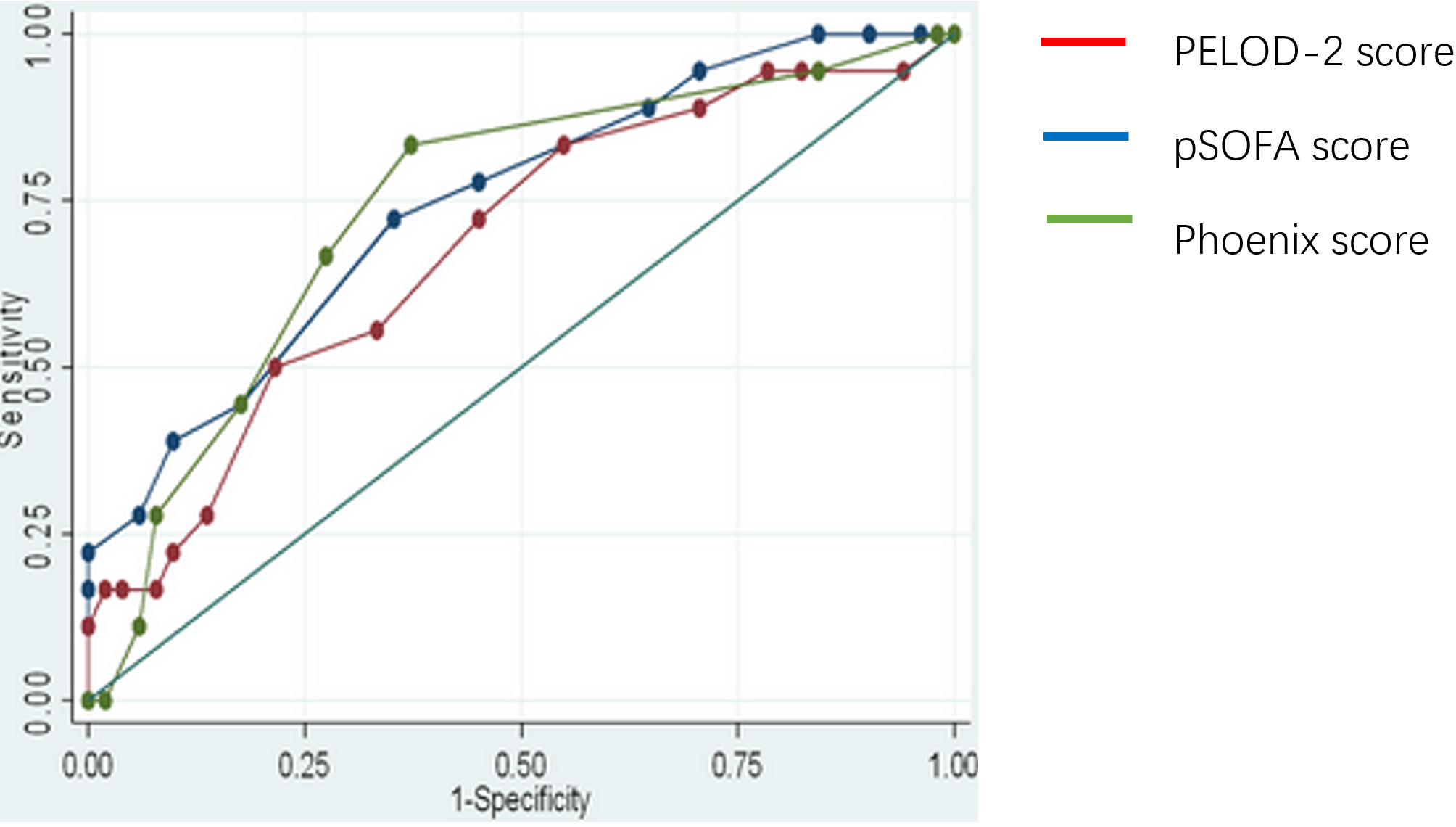
PELOD-2, Pediatric Logistic Organ Dysfunction-2; pSOFA, pediatric Sequential Organ failure Assessment; ROC, receiver operating characteristics.
Table II shows the predictive performance of each score. The Phoenix score, with an optimal cut-off value of 3.5 determined using Youden’s index, demonstrated the highest specificity (70.59%) and the highest PPV (44.44%) among the three scores. In contrast, while the pSOFA and PELOD-2 scores demonstrated the same highest sensitivity of 72.2%, the pSOFA score alone achieved the highest overall accuracy of 66.67%. These findings indicate that the cut-offs selected using Youden’s index provide a balance between sensitivity for predicting mortality in children with clinical sepsis.
| AUROC, area under the receiver operating characteristic curve; CI, confidence interval; NPV, negative predictive value; NLR, negative likelihood ratio; PELOD-2, Pediatric Logistic Organ Dysfunction-2; PLR, positive likelihood ratio; PPV, positive predictive value; pSOFA, pediatric Sequential Organ Failure Assessment. | |||
| Table II. Predictive performance of the pSOFA, Phoenix, and PELOD-2 scores for mortality in children with clinical sepsis. | |||
|
|
|
|
|
| AUROC |
|
|
|
| Cut-off |
|
|
|
| Sensitivity |
|
|
|
| Specificity |
|
|
|
| PPV |
|
|
|
| NPV |
|
|
|
| PLR |
|
|
|
| NLR |
|
|
|
| Accuracy |
|
|
|
| 95% CI |
|
|
|
The comparative predictive performance of the scores for pediatric clinical sepsis mortality was evaluated using the AUC and compared using the DeLong test. The results are presented in Table III.
| AUROC, area under the receiver operating characteristic curve; PELOD-2, Pediatric Logistic Organ Dysfunction-2; pSOFA, pediatric Sequential Organ failure Assessment | ||||||
| Table III. Comparative predictive performance scores for pediatric clinical sepsis mortality. | ||||||
| Comparison |
|
|
|
|
|
|
| Phoenix vs pSOFA |
|
|
|
|
|
|
| Phoenix vs PELOD-2 |
|
|
|
|
|
|
| pSOFA vs PELOD-2 |
|
|
|
|
|
|
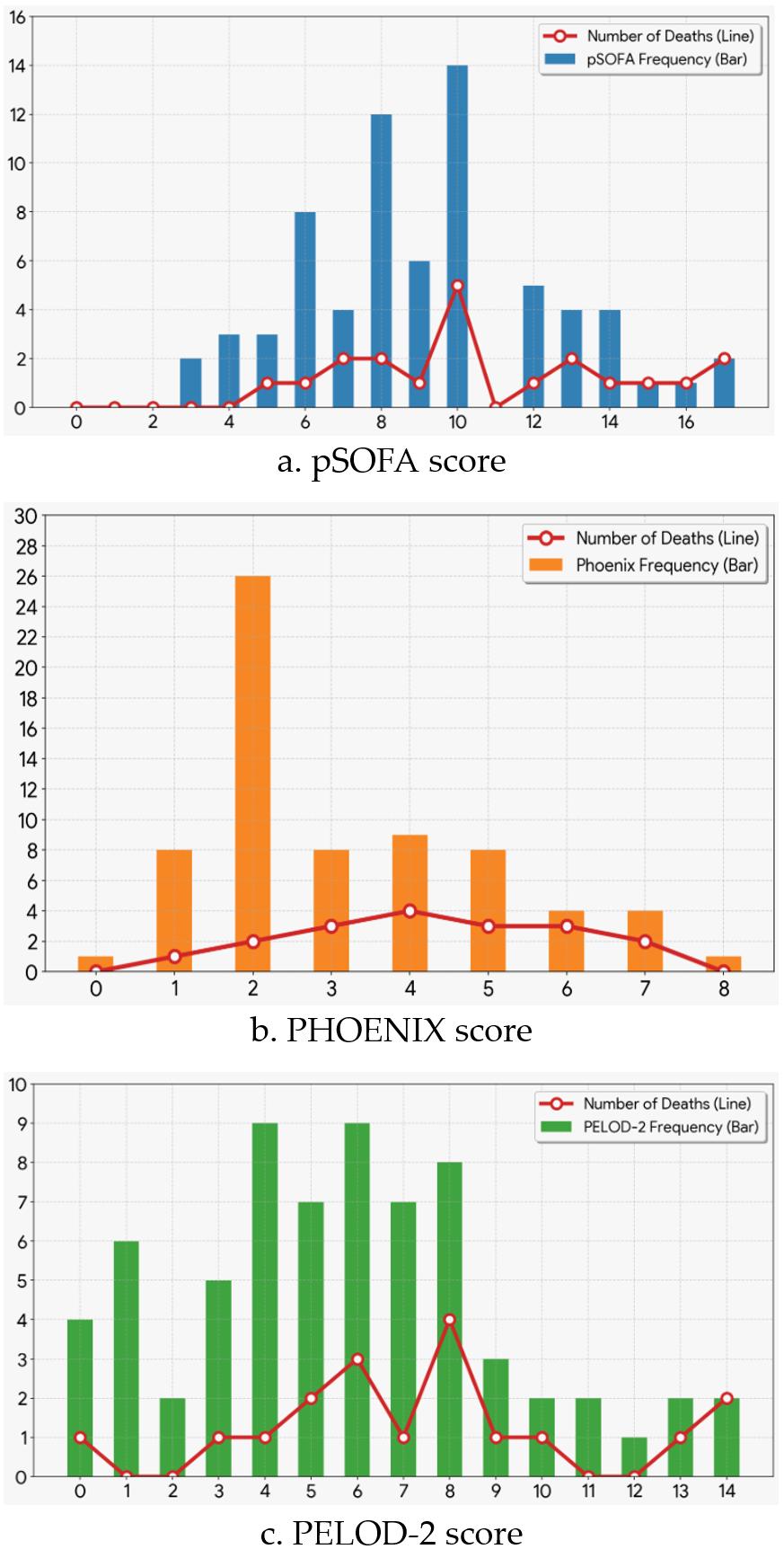
The distribution of mortality among children with clinical sepsis according to pSOFA, Phoenix and PELOD-2 scores can be seen in Fig. 2.
Discussion
Sepsis is the most common presentation in the pediatric intensive care unit (PICU) and the leading cause of morbidity and mortality.14 Consequently, it is important for clinicians to accurately predict patient risk within a few days of treatment. The use of a scoring system in the PICU can facilitate decision-making and appropriate management.14,15 Scoring systems are also useful in predicting outcomes and and aiding immediate intervention.14 The ideal prognostic scoring system should be accurate, simple, easy to use, minimally invasive and inexpensive.16 Various organ dysfunction scores have been developed and validated such as the PELOD-2 score, pSOFA score and more recently, the Phoenix score. This study compared the performance of these three scoring systems in predicting mortality in children with clinical sepsis.
The PELOD-2 score, an update of the original PELOD score, was developed in 2013. This score evaluates 10 variables across 5 organ systems (neurological, cardiovascular, renal, respiratory, and hematologic systems).17 The PELOD-2 score on the first day was reported as a predictor of mortality in pediatric sepsis patients admitted to PICUs in developing countries18 and tertiary hospitals in rural areas.19 A descriptive analytical study conducted from January 2018 to December 2019 in the PICU of Cipto-Mangunkusumo Hospital Jakarta showed that the PELOD-2 score had an AUROC value of 0.842 (95% confidence interval [CI]: 0.843-0.845) in predicting mortality in children with sepsis. This study found an optimal cut-off value of 6.5, with a sensitivity of 77.1% and a specificity of 75%.20 The cut-off value in that study was close to that found in the present study, namely 6.
The pSOFA score was developed in 2017 from the adult SOFA score. Two approaches were used to make modifications. First, age-adjusted renal and cardiovascular variables were validated using the cut-off values of the PELOD-2 score. Second, the respiratory variable score was expanded by measuring the ratio of SpO2 to FiO2 as an alternative marker of lung injury.21,22 The pSOFA score was reported to have excellent performance in predicting mortality in pediatric patients with suspected or confirmed infection with an AUROC of 0.94 (95% CI: 0.92-0.95),22 assessing the prognosis of pediatric patients with sepsis in PICUs of developing countries (AUROC 0.937; 95% CI: 0.913-0.957),18 and in predicting mortality among critically ill pediatric patients admitted to the PICU (AUROC 0.86; 95% CI: 0.79-0.93),23 although the optimal cut-off values differed across studies. Another study reported that the pSOFA score can predict 28-day mortality in pediatric sepsis patients with an AUC of 0.88, but was less effective in predicting length of stay in the PICU.16 The optimal cut-off point value of the pSOFA score in this study was quite high, at 9.5, which differed from those reported in previous studies.
The Phoenix score was developed in 2024 from an analysis of 218,839 suspected episodes of infection and has been validated internationally.12 This score assesses only four organ systems: the respiratory, cardiovascular, neurological, and coagulation systems.8,24 A large-scale study of 10 hospitals from 5 countries (USA, Bangladesh, Colombia, China, and Kenya) definitively reported that the Phoenix score had area under the precision-recall curve (AUPRC) values of 0.23–0.38 (95% CI: 0.20–0.39) and AUROC values of 0.71–0.92 (95% CI: 0.70–0.92) in predicting mortality in both internal and external validation settings. The Phoenix score was also directly linked to the number of deaths.24 Another study in a tertiary hospital in Vietnam reported that the Phoenix score had good prognostic performance in predicting mortality (AUROC 0.885). The optimal cut-off value in that study was 5.5 with 60% sensitivity, 100% specificity and 100% PPV. The Phoenix score was reported to identify high-risk patients early, thereby facilitating timely intervention and improving outcomes.13 The optimal cut-off value differed from that found in the present study which was 3.5.
The implementation of a scoring system in Indonesia must consider the availability of laboratory parameters, the training of medical staff, and the ability to integrate the scores into daily clinical workflows. Of the three scoring systems compared, the Phoenix score is the simplest. The pSOFA score evaluates six organ systems, and the PELOD-2 score evaluates five. Although the pSOFA score was superior to the other two scores, the Phoenix score requires fewer laboratory tests than the other two scoring systems. This makes it more practical to implement in healthcare facilities with limited resources.
This study found that the pSOFA and Phoenix scores were superior predictors of mortality in children with clinical sepsis than the PELOD-2 score. Based on a large-scale database, the AUPRC value of the Phoenix score was reported to be higher than that of PELOD2 score 0.11-0.35 (95% CI: 0.10-0.35) and pSOFA 0.14-0.33 (95% CI: 0.13-0.34). The AUROCs of pSOFA, Phoenix, and PELOD-2 scores ranged from 0.70-0.93, indicating that all three scores can predict mortality in pediatric patients with suspected or confirmed infection.24 Another study in Korea reported that the Phoenix, Phoenix-8, and pSOFA scores had similar performance in predicting mortality among patients with sepsis and septic shock admitted to the PICU, with an AUC range of 0.85 to 0.88.25 The superiority of the pSOFA score over the PELOD-2 score has been widely reported. Retrospective observational cohort studies conducted at Dr. Sutomo Hospital from January to December 2018 26 and at RSUD Dr. Moewarli Surakarta from September to March 2019 27 demonstrated that the pSOFA score performed better than the PELOD-2 score in predicting mortality in pediatric sepsis patients.
A prospective observational study in India conducted from November 2020 to November 2022 definitively reported that PRISM 4, PIM 3, PELOD-2, and pSOFA scores on the first day of care were positively correlated with mortality among critically ill pediatric patients in the PICU. This indicates that the ability of these scoring systems to differentiate between survivors and non-survivors. The pSOFA score was reported to be better at predicting mortality than the PELOD-2 score.15 Another retrospective observational study in China from December 2014 to December 2019 demonstrated the superiority of pSOFA in predicting mortality in pediatric sepsis patients over PRISM III, PELOD-2, and pMODS scores (AUROC 0.847 vs. 0.799 vs. 0.780 vs. 0.715). The optimal cut-off point value of pSOFA for predicting mortality was 7, with a sensitivity of 88.07% and a specificity of 64.71%.28
Sandinirwan et al. reported in 2025 that the PELOD-2 score outperformed the Phoenix score in predicting mortality among pediatric patients with septic shock (AUROC 0.73 vs. 0.59). The optimal cut-off value was 4, which is close to the cut-off value in our study, with a sensitivity of 62% and a specificity of 62%. The study had a very small sample size of only 16 patients with severe disease, and the mortality rate was 50%.29
The differences in the optimal cut-off values of each scoring system across studies may be due to differences in sample heterogeneity, disease severity at time of assessment, the number of samples, and the underlying conditions of the included patients. The limitations of this study are that (1) it was a retrospective observational study, therefore the available data were insufficient to fully evaluate the coagulation system in the Phoenix score; and (2) the study relied on secondary data and had a relatively small sample size for comparing the scores. A post-hoc power analysis of the AUC differences yielded an estimated power of approximately 5% for the Phoenix vs. pSOFA comparison (ΔAUROC = 0.004), and 70–80% for both the Phoenix vs. PELOD-2 (ΔAUROC = 0.059) and pSOFA vs. PELOD-2 (ΔAUROC = 0.063) comparisons. These results indicate that, although the study was underpowered to detect very small differences, the sample size was sufficient to detect moderate differences in the predictive performance of the scores. Therefore, prospective studies with larger sample sizes are warranted to further compare predictive performance and provide more detailed insights. In conclusion, the pSOFA and Phoenix scores showed better performance in predicting mortality in children with clinical sepsis than the PELOD-2 score. Both scores are suitable for use in clinical practice, taking into account factors sus as simplicity, effectiveness, and alignment with local resources. Specifically, the Phoenix and pSOFA scores may be implemented in clinical settings in Indonesia.
Ethical approval
The study was approved by Faculty of Medicine Universitas Indonesia Institutional Review Board [Approval number 0046/UN.F1/ETIK/2018].
Source of funding
The authors declare the study received no funding.
Conflict of interest
The authors declare that there is no conflict of interest.
References
- Rodriguez I, Deep A. Phoenix criteria for sepsis: are these enough to guide a clinician? Eur J Pediatr 2024; 183: 5033-5035. https://doi.org/10.1007/s00431-024-05767-1
- Mishra R, Rup AR, Aggarwal B, Behera JR. Evolution of the concept of sepsis scoring systems in pediatrics to predict mortality and outcomes. Cureus 2024; 16: e74725. https://doi.org/10.7759/cureus.74725
- Gyawali B, Ramakrishna K, Dhamoon AS. Sepsis: the evolution in definition, pathophysiology, and management. SAGE Open Med 2019; 7: 2050312119835043. https://doi.org/10.1177/2050312119835043
- World Health Organization (WHO). Global report on the epidemiology and burden of sepsis: current evidence, identifying gaps and future directions. WHO; 2020. Available at: https://www.who.int/publications/i/item/9789240010789
- Watson RS, Carrol ED, Carter MJ, Kissoon N, Ranjit S, Schlapbach LJ. The burden and contemporary epidemiology of sepsis in children. Lancet Child Adolesc Health 2024; 8: 670-681. https://doi.org/10.1016/S2352-4642(24)00140-8
- Tan B, Wong JJM, Sultana R, et al. Global case-fatality rates in pediatric severe sepsis and septic shock: a systematic review and meta-analysis. JAMA Pediatr 2019; 173: 352-362. https://doi.org/10.1001/jamapediatrics.2018.4839
- Singer M, Deutschman CS, Seymour CW, et al. The third international consensus definitions for sepsis and septic shock (sepsis-3). JAMA 2016; 315: 801-810. https://doi.org/10.1001/jama.2016.0287
- Schlapbach LJ, Watson RS, Sorce LR, et al. International consensus criteria for pediatric sepsis and septic shock. JAMA 2024; 331: 665-674. https://doi.org/10.1001/jama.2024.0179
- Dewi R. Pediatric sequential organ failure assessment score: modified scoring system for sepsis in pediatrics patient. J Indon Med Assoc 2020; 70: 32-37. https://doi.org/10.47830/jinma-vol.70.2-2020-176
- Jordan J, Nguyen CM, Fletcher LM, Garbern SC. Clinical prognostic models in children with sepsis in low- and middle-income countries: a systematic review and meta-analysis. Front Pediatr 2024; 12: 1463986. https://doi.org/10.3389/fped.2024.1463986
- Ministry of Health of the Republic of Indonesia. Keputusan Menteri Kesehatan Republik Indonesia Nomor HK.01.07/MENKES/4722/2021 Tentang Pedoman Nasional Pelayanan Kedokteran Tata Laksana Sepsis Pada Anak [Decree of the Minister of Health of the Republic of Indonesia Number HK.01.07/Menkes/4722/2021 Regarding National Guidelines for Medical Services: Management of Sepsis in Children]. Jakarta: Ministry of Health of the Republic of Indonesia; 2021. Available at: https://kemkes.go.id/app_asset/file_content_download/1700107231655593df097836.23587693.pdf (Accessed on May 17, 2026).
- Hadzhieva-Hristova A, Krumova D, Stoeva T, Georgieva R, Iotova V. Assessment of phoenix sepsis score, pSOFA, PELOD-2, and PRISM III in pediatric intensive care. Children (Basel) 2025; 12: 262. https://doi.org/10.3390/children12030262
- Nguyen-Huu CD, Phan BN, Nguyen VT. Implementation of the phoenix sepsis score in vietnamese pediatric patients: prognostic accuracy and comparative analysis with neutrophil-lymphocyte ratio. Guncel Pediatri 2024; 22: 163-169. https://doi.org/10.4274/jcp.2024.62343
- Gogoi A, Kirtheka PS. Evalution of pediatric sequential organ failure assessment score in predicting the mortality evaluation of pediatric Sequential Organ Failure Assessment score (pSOFA) in predicting the mortality and outcome of the patients admitted in pediatric ICU in tertiary care hospital. Journal of Medical Sciences and Health 2025; 11: 68-73. https://doi.org/10.46347/jmsh.v11.i1.24.211
- Jyotsna, Kumar R, Sharan S, Kishore S, Prakash J. the various scoring systems in pediatric intensive care units: a prospective observational study. Cureus 2023; 15: e39679. https://doi.org/10.7759/cureus.39679
- Mohamed El-Mashad G, Said El-Mekkawy M, Helmy Zayan M. Paediatric sequential organ failure assessment (pSOFA) score: a new mortality prediction score in the paediatric intensive care unit. An Pediatr (Barc) 2020; 92: 277-285. https://doi.org/10.1016/j.anpede.2019.11.001
- Leteurtre S, Duhamel A, Salleron J, et al. PELOD-2: an update of the PEdiatric logistic organ dysfunction score. Crit Care Med 2013; 41: 1761-1773. https://doi.org/10.1097/CCM.0b013e31828a2bbd
- Zhong M, Huang Y, Li T, et al. Day-1 PELOD-2 and day-1 “quick” PELOD-2 scores in children with sepsis in the PICU. J Pediatr (Rio J) 2020; 96: 660-665. https://doi.org/10.1016/j.jped.2019.07.007
- Deshmukh T, Varma A, Damke S, Meshram R. Predictive efficacy of pediatric logistic organ dysfunction-2 score in pediatric intensive care unit of rural hospital. Indian J Crit Care Med 2020; 24: 701-704. https://doi.org/10.5005/jp-journals-10071-23528
- Dewi R, Fatimatuzzuhroh. Profil pasien sakit kritis yang dirawat di Pediatric Intensive Care Unit Rumah Sakit Cipto Mangunkusumo berdasar sistem skoring Pediatric Logistic Organ Dysfunction-2 [Critically ill patient’s profile in Pediatric Intensive Care Unit Cipto Mangunkusumo Hospital based on Pediatric Logistic Organ Dysfunction-2]. Sari Pediatri 2019; 21: 37-43. https://doi.org/10.14238/sp21.1.2019.37-43
- Mianling Z, Yuge H, Tufeng L, Lu X, Ting T, Miaofen L, et al. Performance of the pediatric sequential organ failure assessment score in assessing the prognosis of children with sepsis in a PICU of a developing country: a single-center retrospective observational study. Iran J Pediatr 2019; 29. https://doi.org/10.5812/ijp.89024
- Matics TJ, Sanchez-Pinto LN. Adaptation and validation of a pediatric sequential organ failure assessment score and evaluation of the sepsis-3 definitions in critically Ill children. JAMA Pediatr 2017; 171: e172352. https://doi.org/10.1001/jamapediatrics.2017.2352
- Chaudhari M, Bhavsar M, Shah SP, Parmar A, Dhamsaniya D. Paediatric assessment score as predictor of mortality in pediatric intensive care units. Int J Contemp Pediatrics 2025; 12: 567-74. https://doi.org/10.18203/2349-3291.ijcp20250759
- Sanchez-Pinto LN, Bennett TD, DeWitt PE, et al. Development and validation of the phoenix criteria for pediatric sepsis and septic shock. JAMA 2024; 331: 675-686. https://doi.org/10.1001/jama.2024.0196
- Han CH, Kim H, Park M, et al. Validation of the phoenix criteria for sepsis and septic shock in a pediatric intensive care unit. J Korean Med Sci 2025; 40: e106. https://doi.org/10.3346/jkms.2025.40.e106
- Siampa JP, Utariani A, Hanindito E. Mortality assesment of pediatric septic patients through pediatric sofa+anion gap and pelod-2 scores. Folia Medica Indonesiana 2022; 5: 298-304
- Wulandari A, Pudjiastuti, Martuti S. Severe sepsis criteria, PELOD-2, and pSOFA as predictors of mortality in critically ill children with sepsis. Paediatrica Indonesiana 2019; 59: 318-324. https://doi.org/10.14238/pi59.6.2019.318-24
- Zhang LD, Wang L, Wu YH, et al. pSOFA score serves as predicting the severity and outcome of sepsis in critically ill children. Sci Rep 2025; 15: 43595. https://doi.org/10.1038/s41598-025-19287-x
- Sandinirwan I, Meilyana F, Peryoga SU, et al. Comparative accuracy of the Phoenix sepsis score and PELOD-2 in predicting mortality among pediatric septic shock patients: a pilot study. Paper presented at: Asian Pediatric Intensive Care-Medicine Congress; 2025 May 9-11; Bali, Indonesia.
Copyright and license
Copyright © 2026 The Author(s). This is an open access article distributed under the Creative Commons Attribution License (CC BY), which permits unrestricted use, distribution, and reproduction in any medium or format, provided the original work is properly cited.