Video Abstract
Graphical Abstract
Abstract
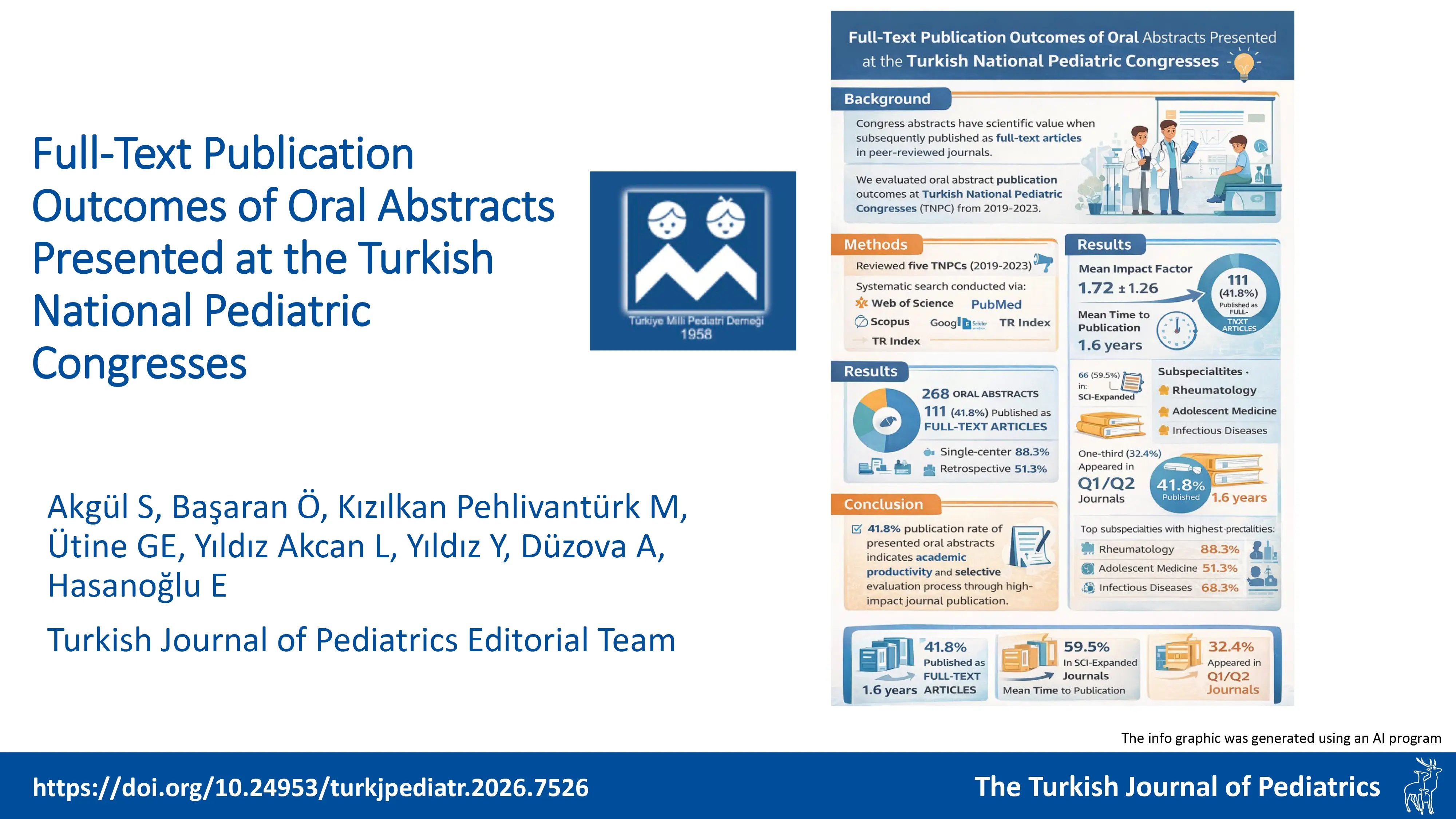
Background. Scientific congresses are critical platforms for knowledge dissemination and collaboration. The scientific value of presented abstracts is best demonstrated through their subsequent publication as full-text articles in peer-reviewed journals. This study aimed to evaluate the publication rate and characteristics of oral abstracts presented at the Turkish National Pediatric Congresses (TNPC) between 2019 and 2023.
Methods. Abstract books of five consecutive congresses were reviewed. The publication status of each abstract was determined through systematic searches in Web of Science, PubMed, Scopus, Google Scholar and the TR Index utilizing the title, keywords from the title and author names. Parameters such as study design, collaboration type, index status and the impact factor of the journal, the year it was published, and time to publication were analyzed. Additionally, the subspecialty of each abstract and the publication rate for each subspecialty were evaluated.
Results. Among 268 oral abstracts, 111 (41.8%) were published as full-text articles. Of these, 66 (59.5%) were published in journals indexed in the Science Citation Index Expanded. Approximately one-third (32.4%) of the articles were published in Q1 or Q2 ranked journals. The average impact factor was 1.72 ± 1.26 and the mean time to publication was 1.6 ± 1.17 years. The most common study design published was retrospective (51.3%), and the majority were single-center studies (88.3%). The highest publication rates were observed in the fields of rheumatology, adolescent medicine, and infectious diseases.
Conclusion. A significant portion of the papers presented at TNPC congresses are published in peer-reviewed scientific journals. The fact that more than one-third of the published studies appear in high-impact journals demonstrates the academic quality of the papers presented at the congresses and the effectiveness of the selective evaluation process. The findings provide valuable contributions to the monitoring and development of academic productivity in the field of pediatrics in Türkiye.
Keywords: Publication rate, scientific congress, pediatric abstracts, Türkiye, bibliometric analysis
Introduction
Scientific congresses represent essential venues for sharing emerging research, offering investigators the opportunity to present preliminary results to the academic community and for networking for future collaborations. While such presentations are valuable for fostering dialogue and early feedback, their lasting scientific contribution depends largely on subsequent full-text publication.1 This transition not only facilitates peer validation and wider dissemination, but also ensures that the research becomes a citable part of the scholarly record, enabling further inquiry and application. Additionally, presentations of research with stronger scientific and methodological quality also encourages higher-quality submissions to future congresses. Assessing the rate at which conference abstracts are converted into full-text publications is therefore of critical importance, as it reflects not only the scientific quality and methodological rigor of the presented research but also the academic influence and credibility of the conferences themselves.2 Reported publication rates following conference presentations vary across medical specialties, typically ranging from 34% to 59%.3
The Turkish National Pediatric Society (TNPS), founded in Ankara in 1958 by Prof. Dr. İhsan Doğramacı, has played a leading role in advancing pediatric healthcare in Türkiye for over six decades. With 24 branches across various provinces, the Society has made significant contributions to the improvement of child health through education, advocacy, and scientific exchange. As part of its mission, TNPS has organized 68 Turkish National Pediatric Congresses (TNPCs), which bring together thousands of healthcare professionals annually. These congresses provide a forum for the presentation of current issues in pediatric health and the latest scientific developments by both nationally and internationally recognized experts. In addition to promoting high-quality, evidence-based education, the congresses foster professional networking among pediatricians. Each year, approximately 50 oral abstracts are presented, offering pediatricians across the country an opportunity to share their research with a broader academic audience.
TNPS also publishes two academic journals in collaboration with the Hacettepe University Institute of Child Health and the International Children’s Center. Among them, The Turkish Journal of Pediatrics (TJP), published bimonthly since 1958, is indexed in the Science Citation Index-Expanded. As the editorial board of TJP, we recognized that, despite the rigorous peer-review process used for oral abstract selection at TNPCs, limited data exist regarding the proportion of these abstracts that are ultimately published as full-text articles and the characteristics of those publications.
This study aims to address this gap by evaluating the publication rate of oral abstracts presented at TNPCs and analyzing the associated characteristics of the resulting full-text publications over a five-year period (2019-2023).
Materials and Methods
Study design and data collection
The study included five TNPCs held between 2019 and 2023. Oral abstracts were identified from official congress abstract books. A master list of all oral abstracts was compiled; poster abstracts were not evaluated. Abstracts from the past two congresses (2024 and 2025) were not included in the analysis, as an adequate time interval is required for the studies to progress to full-text publication.
Search strategy
Each abstract was searched in PubMed, Web of Science, Scopus, Google Scholar and TR Index using author names, abstract titles, and title keywords. Both English and Turkish titles were used in the search. Each year was evaluated independently by two researchers. Publications matching the abstracts were counted as “converted abstracts”.
Variables analyzed
The following data were collected: Pediatric subspecialty category, year of presentation, study design (retrospective, prospective or cross-sectional), collaboration (single-center, multicenter, international), time to publication (years), journal indexing status (Science Citation Index Expanded [SCIE], Social Sciences Citation Index [SSCI], Emerging Sources Citation Index [ESCI], TR Index (also known as TR Dizin), and others [journals not indexed in any of the aforementioned databases]) and for those indexed in the Web of Science, journal impact factor and quartile (Q) category of the journal at the time of publication, as reported by Clarivate Journal Citation Reports.
Statistical analysis
Descriptive statistics were used. Numerical variables were presented as mean ± standard deviation (SD), and categorical data as frequency and percentage. All analyses were performed using IBM SPSS Statistics for Windows, Version 21.0 (IBM Corp., Armonk, NY, USA).
Results
Out of 268 oral abstracts presented between 2019 and 2023, a total of 111 (41.8%) were subsequently published as full-text articles in peer-reviewed journals. The year-by-year distribution of publication rates and related characteristics is presented in Table I. The highest annual conversion rate was observed in 2019 (50.0%), and the lowest in 2023 (29.1%).
| Impact factors and quartile categories pertain only to articles published in journals indexed in the Web of Science and have those parameters reported in the Journal Citation Reports. TR Index is also known as TR-Dizin; *One study published in The Lancet in 2020 (Impact Factor: 99.7) was excluded from impact factor analysis due to being an outlier; ESCI: Emerging Sources Citation Index, SCIE: Science Citation Index Expanded, SSCI: Social Sciences Citation Index. | |||||||
| Table I. Annual publication rates and characteristics of abstracts. | |||||||
| Year | Published / total abstracts, n (%) | Study design, n (%) | Collaboration level, n (%) | Time to publication (years), mean ± SD (min–max) | Journal indexing status, n | Quartile (Q), n | Impact factor, mean ± SD (min–max) |
| 2019 | 30 / 60 (50.0%) |
Retrospective: 13 (43.3%) Cross-sectional or Prospective: 17 (56.7%) |
Single-center: 28 (93.3%) Multicenter: 1 (3.3%) International: 1 (3.3%) |
2.26 ± 1.4 (0–6) |
SCIE: 22 SSCI: 0 ESCI: 2 Other: 1 TR Index: 5 |
Q1: 5 Q2: 5 Q3: 10 Q4: 4 |
2.0 ± 1.2 (0.1–4.8) |
| 2020 | 29 / 63 (47.6%) |
Retrospective: 11 (37.9%) Cross-sectional or Prospective: 18 (62.1%) |
Single-center: 24 (82.8%) Multicenter: 3 (10.3%) International: 2 (6.9%) |
1.62 ± 1.1 (0–4) |
SCIE: 17 SSCI: 1 ESCI: 4 Other: 3 TR Index: 4 |
Q1: 2 Q2: 6 Q3: 5 Q4: 10 |
1.75 ± 1.5 (0.04–4.84) |
| 2021 | 17 / 38 (44.7%) |
Retrospective: 11 (64.7%) Cross-sectional or Prospective: 6 (35.3%) |
Single-center: 13 (76.5%) Multicenter: 4 (23.5%) International: 0 |
1.58 ± 1.06 (0–4) |
SCIE: 7 SSCI: 0 ESCI: 4 Other: 3 TR Index: 3 |
Q1: 2 Q2: 1 Q3: 2 Q4: 6 |
1.38 ± 1.08 (0.2–3.5) |
| 2022 | 19 / 52 (36.5%) |
Retrospective: 10 (52.6%) Cross-sectional or Prospective: 9 (47.4%) |
Single-center: 19 (100%) Multicenter: 0 International: 0 |
1.47 ± 0.68 (0–3) |
SCIE: 7 SSCI: 1 ESCI: 7 Other: 1 TR Index: 3 |
Q1: 4 Q2: 2 Q3: 2 Q4: 7 |
1.44 ± 1.34 (0.1–4.3) |
| 2023 | 16 / 55 (29.1%) |
Retrospective: 12 (75%) Cross-sectional or Prospective: 4 (25%) |
Single-center: 14 (87.5%) Multicenter: 2 (12.5%) International: 0 |
0.9 ± 0.68 (0–2) |
SCIE: 13 SSCI: 0 ESCI: 2 Other: 1 TR Index: 0 |
Q1: 2 Q2: 7 Q3: 1 Q4: 4 |
1.77 ± 0.93 (0.1–3.1) |
| Total | 111 / 268 (41.8%) |
Retrospective: 57 (51.35%) Cross-sectional or Prospective: 54 (48.65%) |
Single-center: 98 (88.29%) Multicenter: 10 (9.0%) International: 3 (2.7%) |
1.6 ± 1.17 (0–6) |
SCIE: 66 SSCI: 2 ESCI: 19 Other: 9 TR Index: 15 |
Q1: 15 Q2: 21 Q3: 20 Q4: 31 |
1.72 ± 1.26 (0.04–4.84) |
Fig. 1. illustrates the distribution of time from abstract presentation to publication, stratified by presentation year. The majority of publications occurred within 3 years for all cohorts.
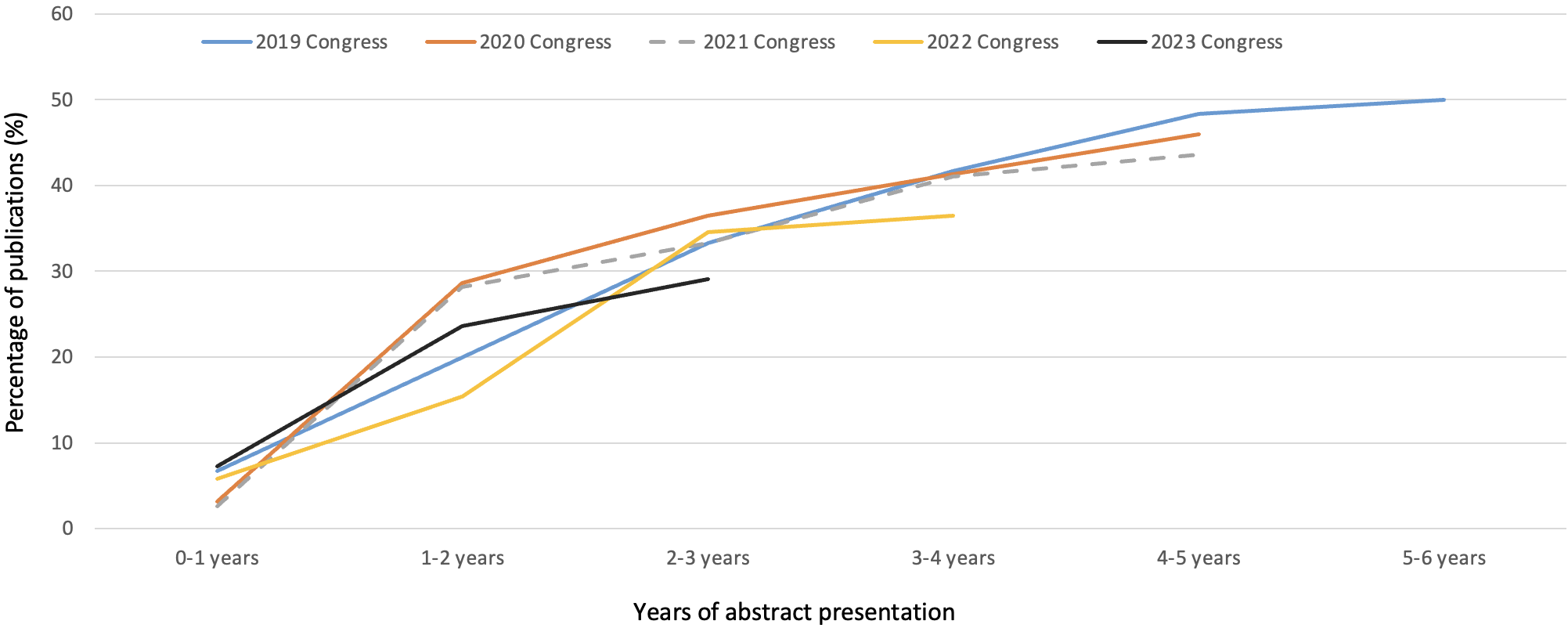
Among the published abstracts, 61.3% (n=68) appeared in journals indexed in SCIE or SSCI, while 17.1% (n=19) were published in journals indexed in ESCI. Publications in journals indexed in TR Index constituted 13.5% (n=15) of the total of published articles. The mean time to publication was 1.6 ± 1.17 years, with a range from 0 to 6 years. Most of the published studies were retrospective in design (51.3%) and conducted in a single center (88.3%), while only three (2.7%) were the result of international collaborations.
The mean journal impact factor was 1.72 ± 1.26 (range: 0.04–4.84). One study published in The Lancet in 2020 (impact factor: 99.7) was excluded from the impact factor analysis due to its outlier status. Approximately one-third (32.4%) of the articles were published in Q1 or Q2 ranked journals.
Subspecialties with the highest number of abstracts submitted included Infectious Diseases (n=32), Neonatology (n=24), and Social Pediatrics (n=23). Table II presents the distribution of abstracts and publication rates by pediatric subspecialty. The highest conversion rates were observed in Pediatric Rheumatology: 100% (5/5) and Adolescent Medicine: 71.4% (5/7).
| *Presented in alphabetical order. | ||
| Table II. Number of abstracts and full-text publication rates by pediatric subspecialty. | ||
| Subspecialty* |
|
|
| Adolescent health |
|
|
| Allergy |
|
|
| Cardiology |
|
|
| Developmental pediatrics |
|
|
| Emergency medicine |
|
|
| Endocrinology |
|
|
| Gastroenterology |
|
|
| General pediatrics |
|
|
| Genetics |
|
|
| Hematology |
|
|
| Immunology |
|
|
| Infectious diseases |
|
|
| Intensive care |
|
|
| Metabolism |
|
|
| Neonatology |
|
|
| Nephrology |
|
|
| Neurology |
|
|
| Non-pediatric specialty |
|
|
| Oncology |
|
|
| Pulmonology |
|
|
| Rheumatology |
|
|
| Social pediatrics |
|
|
| Total |
|
|
Discussion
Since its establishment, the TNPS has organized annual national pediatric congresses that have evolved into cornerstone events in the field. These meetings bring together leading experts from Türkiye and abroad to present the latest research and clinical advancements. Although the abstracts submitted to TNPS congresses have the potential to significantly influence pediatric practice, no prior systematic evaluation has assessed how many of these presentations successfully undergo peer review and achieve full-text publication. This study demonstrates that nearly half of the oral abstracts presented at TNPCs were subsequently published as full-text articles, a rate that aligns with findings from other international congresses. A 2018 Cochrane review examining 425 studies and 307,028 scientific meeting abstracts reported a mean full-text publication rate of 46.4%.1 In contrast, two studies from other Turkish medical societies in 2014 and 2015, found much lower publication rates of 11% and 21.9%,4,5 suggesting that the publication outcomes of TNPC abstracts compare favorably within the national context.
Despite the relatively high publication rate, it is important to recognize that more than half of the abstracts were not published in peer-reviewed journals. The reasons for non-publication remain unclear; it is not known how many were submitted and subsequently rejected versus never submitted at all. A prior study in 2003, on orthopedics meetings found that 16% of abstracts were submitted but rejected, while 36% were never submitted. The most commonly cited reasons for non-submission included lack of time, ongoing nature of the project, and difficulties in collaboration with co-authors.6 These findings highlight the need to explore and address the barriers that prevent abstracts from being developed into full manuscripts.
The mean time to publication in our study was 1.6 years, consistent with previous reports in the literature. For example, a study of abstracts presented at the Urological Society of Australia and New Zealand’s annual meetings reported a mean time to publication of 1.3 years, with 80% published within two years.7 In our study, the longest observed time to publication was 6 years. Similar trends have been observed across various medical specialties, where publication timelines generally range from 1 to 2 years. This delay likely reflects the time required for manuscript preparation, submission, peer review, and editorial processing.8 The peak in publication rates in 2019 and the decline observed in 2023 may further support this observation.
Similar to the literature, in our study retrospective and single-center studies dominated both the study design and level of collaboration, likely due to their feasibility and ease of data access. However, previous studies have shown that multicenter and international studies are more likely to be published and have greater impact,8emphasizing the importance of promoting collaborative research efforts in future congress submissions.
Subspecialties with the highest number of submitted abstracts included Infectious Diseases, Neonatology, and Social Pediatrics—consistent with the common thematic priorities of general pediatric congresses. It is noteworthy that each subspecialty also maintains its own national society, which may draw high-quality submissions to specialty-specific meetings and thereby limit the number of top-tier abstracts submitted to general pediatric congresses.
This study has several limitations. First, we analyzed only oral abstracts and did not assess the study designs of those that were not published. Previous research has indicated that abstracts presenting randomized controlled trials and those selected for oral presentation are more likely to be published,3 but we were unable to evaluate this factor within the unpublished group. Second, our full-text search was limited to journals indexed in Medline and TR Index. Therefore, it is possible that some publications were missed, although each abstract was independently evaluated by two reviewers to minimize this risk. Another possible reason for some being missed could be that the title of the article, the keywords, or some of the authors may have appeared differently in the publication. Additionally, we were not able to evaluate the reasons for non-publication.
In conclusion, the fact that nearly half of the abstracts were published—over one-third of them in Q1 or Q2 ranked journals—and the relatively short time to publication suggest that the studies presented orally at TNPCs are of high scientific quality and are maturing into full publications in a timely manner. TNPCs contribute meaningfully to the national pediatric research output. These findings highlight the importance of monitoring academic productivity and identifying potential barriers to publication, thereby contributing to the continued development of pediatric research in Türkiye.
Acknowledgements
We would like to thank the Turkish National Pediatric Society for granting access to the abstract books and to the meeting organizing committee for their support in facilitating this process.
Ethical approval
This study did not require ethics committee approval as it involved the analysis of publicly available data from published conference abstract books and did not include human participants or identifiable personal data.
Source of funding
The authors declare the study received no funding.
Conflict of interest
The authors declare that there is no conflict of interest.
References
- Scherer RW, Meerpohl JJ, Pfeifer N, Schmucker C, Schwarzer G, von Elm E. Full publication of results initially presented in abstracts. Cochrane Database Syst Rev 2018; 11: MR000005. https://doi.org/10.1002/14651858.MR000005.pub4
- Scherer RW, Langenberg P, von Elm E. Full publication of results initially presented in abstracts. Cochrane Database Syst Rev 2007; undefined: MR000005. https://doi.org/10.1002/14651858.MR000005.pub3
- Klassen TP, Wiebe N, Russell K, et al. Abstracts of randomized controlled trials presented at the society for pediatric research meeting: an example of publication bias. Arch Pediatr Adolesc Med 2002; 156: 474-479. https://doi.org/10.1001/archpedi.156.5.474
- Beker-Acay M, Fidan N, Unlu E, et al. The fate of abstracts presented at Turkish national radiology congresses in 2010-2012. Diagn Interv Radiol 2015; 21: 322-326. https://doi.org/10.5152/dir.2015.14451
- Erdağ TK, Durmuşoğlu M, Demir AO, Doğan E, Ikiz AO. Analysis and publication rate of the presentations at the Turkish National Otorhinolaryngology and Head and Neck Surgery meetings. Kulak Burun Bogaz Ihtis Derg 2014; 24: 89-96. https://doi.org/10.5606/kbbihtisas.2014.44520
- Sprague S, Bhandari M, Devereaux PJ, et al. Barriers to full-text publication following presentation of abstracts at annual orthopaedic meetings. J Bone Joint Surg Am 2003; 85: 158-163. https://doi.org/10.2106/00004623-200301000-00024
- Yoon PD, Chalasani V, Woo HH. Conversion rates of abstracts presented at the Urological Society of Australia and New Zealand (USANZ) annual scientific meeting into full-text journal articles. BJU Int 2012; 110: 485-489. https://doi.org/10.1111/j.1464-410X.2011.10879.x
- Walker TC, Bembea MM. Stuck at the abstract: where is the article? Pediatr Crit Care Med 2017; 18: 813-814. https://doi.org/10.1097/PCC.0000000000001212
Copyright and license
Copyright © 2026 The Author(s). This is an open access article distributed under the Creative Commons Attribution License (CC BY), which permits unrestricted use, distribution, and reproduction in any medium or format, provided the original work is properly cited.