Graphical Abstract
Abstract
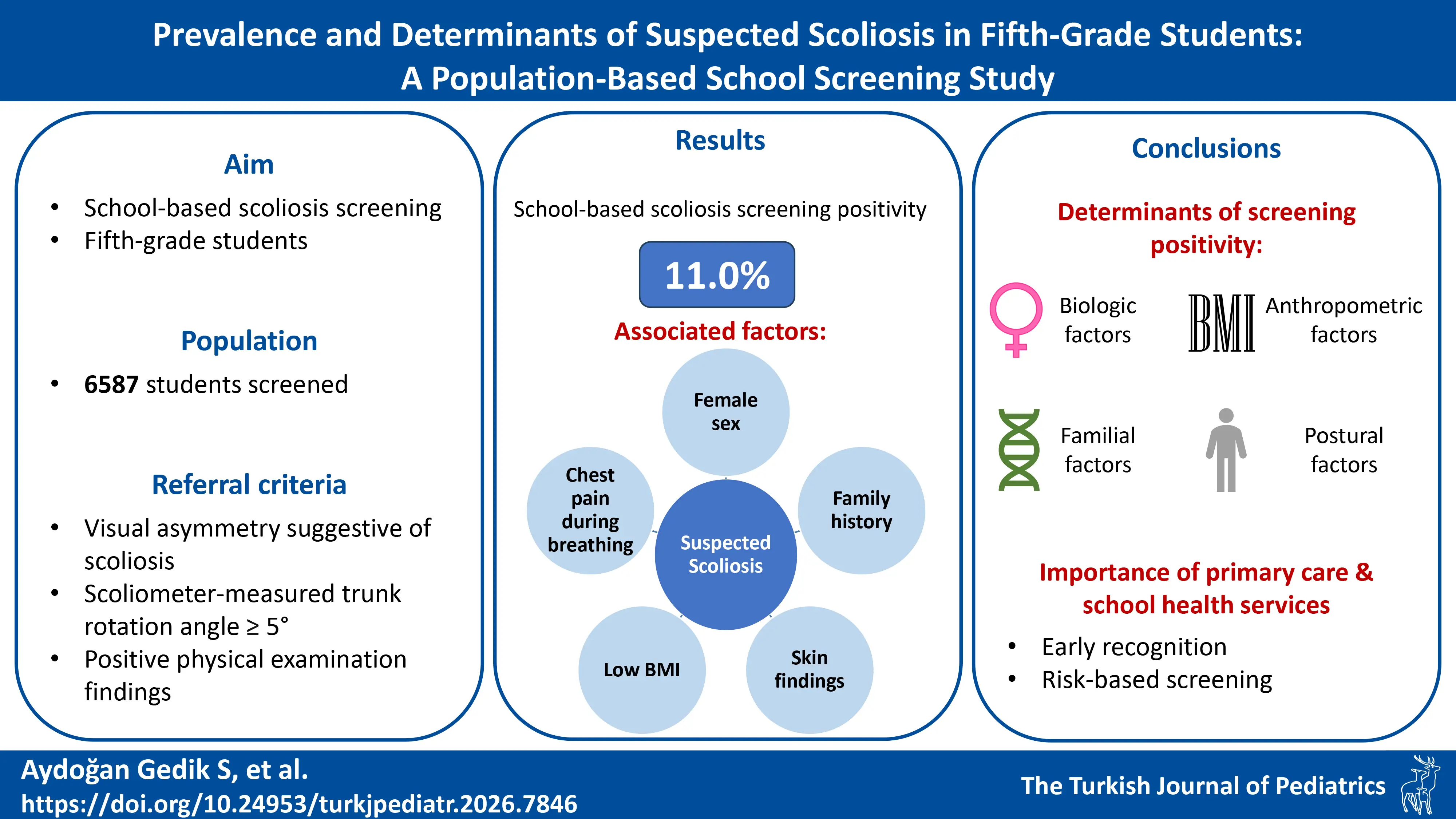
Background. The aim of this study was to conduct school-based scoliosis screening among fifth-grade students and to determine the rate of screening positivity for suspected scoliosis.
Methods. During the 2024–2025 academic year, scoliosis screening was conducted among 6,587 students attending all middle schools in Eskişehir province, Türkiye. Data were collected through scoliosis screening examinations performed by physiotherapists and a questionnaire administered to the students. The screening examinations included visual inspection, the forward bending test, and measurements using a scoliometer. Students with a trunk rotation ≥5° on scoliometer assessment and/or with physical signs such as visual asymmetry, scapular, shoulder, or pelvic imbalance, or apparent leg length discrepancy were referred for specialist evaluation. Chi-square test and logistic regression analysis were performed.
Results. The ages of the students ranged between 10-11 years (mean ± standard deviation: 10.26±0.44). According to the assessments performed by physiotherapists, visual asymmetry suggestive of scoliosis was observed on inspection in 240 students (3.6%). Scoliometer measurements showed trunk rotation angles of 5 degrees or greater in 355 students (5.4%). As a result of the screening examinations, 725 students (11.0%) were screening-positive for suspected scoliosis and were referred to higher-level healthcare facilities for further evaluation. Risk factors were more prevalent among female students. In multivariate analysis, screening positivity for suspected scoliosis was significantly associated with female sex, low body mass index, a family history of scoliosis in first-degree relatives, chest stabbing sensation or pain during breathing, and skin findings on the back (discoloration, large nevi, or localized hypertrichosis).
Conclusions. This study determined that the screening positivity rate for suspected scoliosis among fifth-grade students was 11.0%. Factors that may be associated with scoliosis were found to be more common in female students; however, the multifactorial nature of scoliosis suggests that screening positivity may be influenced by a complex interaction of biological, anthropometric, familial, and postural factors. The findings also highlight the importance of early recognition and risk-based approaches in school-aged populations, and underscore the public health relevance of awareness and screening practices integrated within existing school health services and primary care.
Keywords: school, screening, scoliosis, spinal curvature
Introduction
Scoliosis is a spinal disorder characterized by lateral curvature of the spine to the right or left in an S- or C-shaped pattern, accompanied by vertebral rotation.1 It is the most common spinal deformity.2 Although the etiology of scoliosis varies, it is generally classified as congenital, neuromuscular, syndromic, or idiopathic. Idiopathic scoliosis is the most prevalent type and is further categorized as infantile, juvenile, or adolescent idiopathic scoliosis according to the age of onset. Adolescent idiopathic scoliosis is the most frequently observed, as it develops during periods of rapid physical growth.3-5 Adolescent idiopathic scoliosis develops insidiously in healthy children, with no clearly identifiable cause, and may progress over time. It is reported to affect approximately 2–3% of the adolescent population. Girls aged 10–12 years are at the highest risk for both the development and progression of scoliosis.1,4,6,7 While scoliosis may be suspected on physical examination, a definitive diagnosis is established using radiological imaging. Radiographically, scoliosis is defined as a lateral spinal curvature of 10 degrees or greater.3
Scoliosis may lead to severe pain, functional limitations, progressive deformity, and serious complications involving the cardiopulmonary system. In addition, it can cause psychological, cosmetic, and social problems. Many postural disorders and spinal deformities observed in adulthood, including scoliosis, are known to originate in childhood and may progress during periods of ongoing skeletal growth. Therefore, early recognition is of critical importance.8-10 With early diagnosis following appropriate clinical and radiological evaluation and timely intervention, disease progression can be closely monitored and slowed. Deformities detected at an early stage may be managed with exercise, physical therapy, and brace treatment, thereby preventing progression to a severity that would require surgical intervention. Early supportive interventions also help avoid invasive and costly surgical procedures,8,11,12 ultimately improving quality of life in later years. Early diagnosis also provides social and psychological benefits for both the child and the family.8
Although school-based scoliosis screening programs remain a subject of debate in the literature, with some opposing views, many studies have reported that such programs facilitate early detection, reduce the need for surgery, and are cost-effective. Several studies, countries, and orthopedic associations recommend school screening for scoliosis, particularly in adolescents who are at high risk. Although screening age ranges vary between 7 and 18 years, scoliosis is most commonly detected between the ages of 13 and 15, and screening is generally considered most appropriate between 10 and 14 years of age.4,8,11,13,14 School screenings can identify spinal curvatures that may not be noticed by families or teachers. In a national study, two-thirds of parents of children with a scoliosis angle between 10 and 19 degrees were reported to be unaware of the deformity.15 Another national study found that parental awareness of scoliosis was low among parents of children aged 8–18 years, with most having never heard of the condition and lacking awareness of its risk factors.16
However, school-based scoliosis screening programs remain controversial, and concerns have been raised regarding potential disadvantages. Reported limitations include false-positive results leading to unnecessary referrals, increased healthcare costs, and exposure to additional radiographic examinations, despite potential benefits of early detection shown in recent meta-analyses.17 Furthermore, issues related to potential stigmatization and the psychological impact of scoliosis on adolescents have been documented in the literature, including adverse effects on body image and psychosocial well-being that may influence treatment adherence and quality of life.18,19 Anxiety in children and families following a positive screening result may represent an unintended consequence of such programs.
It should also be noted that scoliosis assessment is generally included in routine adolescent well-child visits in many healthcare systems as part of standard preventive care.20 However, awareness of scoliosis among parents and adolescents is often limited, and attendance at regular preventive health visits during early adolescence may be inconsistent, leading to missed opportunities for early identification.16 In this context, school-based screening may serve as an alternative or complementary strategy, particularly in settings where access to routine follow-up is suboptimal. Careful consideration of both the benefits and limitations of school-based screening is therefore necessary to inform evidence-based policy and clinical practice.
The aim of this study was to conduct scoliosis screening among fifth-grade students attending schools and to determine the screening positivity rate for suspected scoliosis.
Materials and Methods
Study design and study group
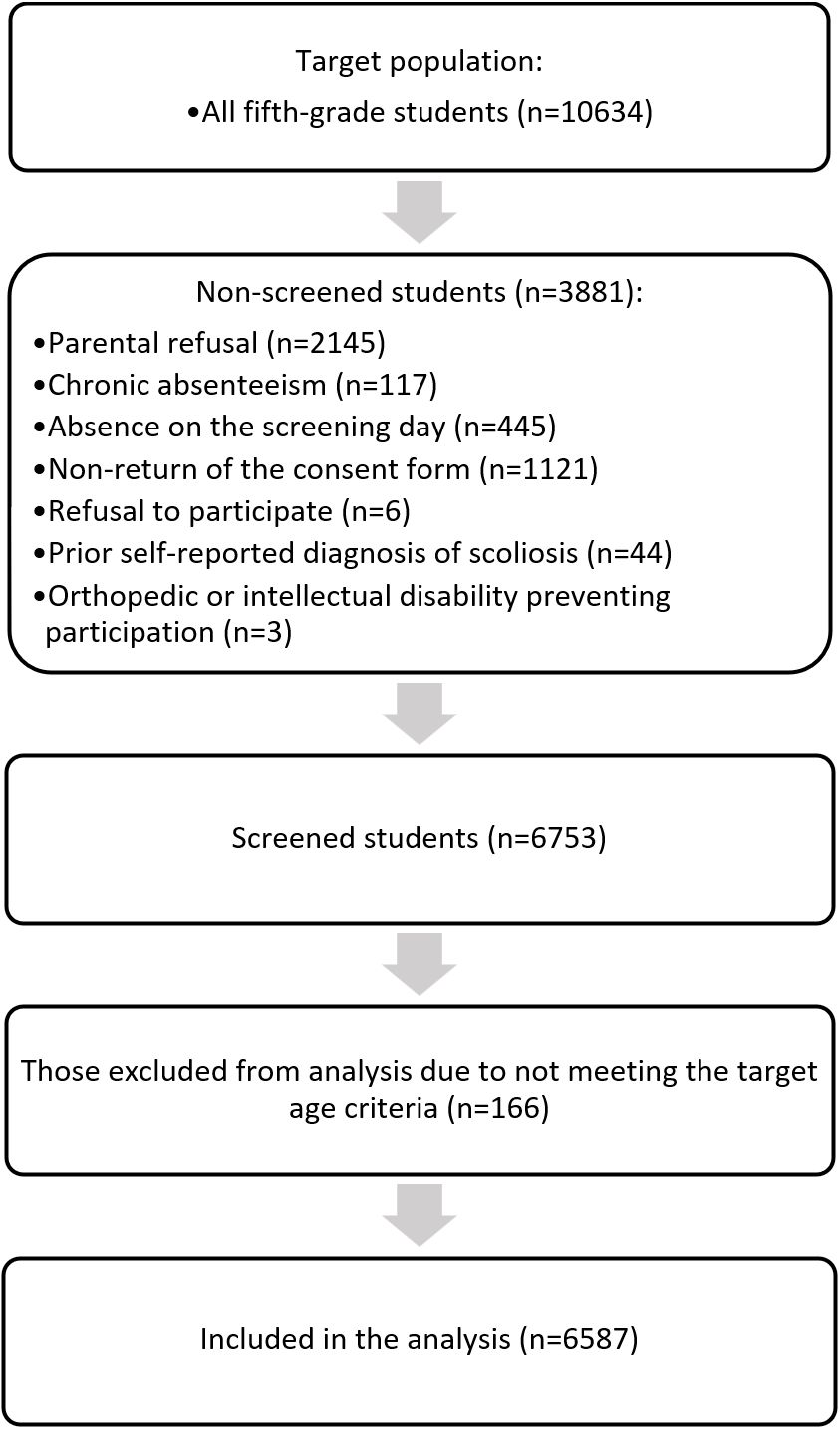
This study was part of a province-based population screening program conducted in Eskişehir Province, located in the Central Anatolia Region of Türkiye. The study was conducted within the scope of the “Early Detection and Screening Program for Scoliosis,” which was implemented under a protocol signed between the Eskişehir Provincial Directorate of National Education and the Eskişehir Provincial Directorate of Health. The program aimed to identify students with suspected scoliosis through screening, ensure appropriate referral for early treatment, and prevent long-term complications. Within this framework, it was planned to reach all fifth-grade students (n=10634) enrolled in middle schools affiliated with the Eskişehir Provincial Directorate of National Education during the 2024–2025 academic year. No sampling method was applied.
Scoliosis screening was performed in all middle schools across the province (n=131) among 6587 students (61.9% of the target population) whose parents provided informed consent and who voluntarily agreed to participate. Screening could not be performed in 2145 students (20.2%) due to parental refusal. In addition, students were not screened due to chronic absenteeism in 117 cases (1.1%), absence on the screening day in 445 cases (4.2%), failure to return the consent form in 1121 cases (10.5%), refusal to participate in 6 cases (0.05%), a self-reported prior diagnosis of scoliosis in 44 cases (0.4%), and the presence of an orthopedic or intellectual disability preventing participation in 3 cases (0.02%). Moreover, a total of 166 (1.6%) students were excluded from the analysis because they reported ages other than 10 or 11, which is the expected age range for 5th grade. They were removed to prevent potential distortion in the interpretation of the results, as they may have been at different stages of growth and maturation. A flowchart illustrating the inclusion and exclusion of participants is presented in Fig. 1.
Data collection
Data were collected through scoliosis screening examinations performed by physiotherapists and a questionnaire administered to the students.
The first section of the questionnaire was completed by the students themselves in the classroom under supervision. This section included questions on sociodemographic characteristics (age, sex, weight, and height) and symptoms potentially associated with scoliosis, such as a family history of scoliosis in first-degree relatives; a sensation of stabbing or pain in the chest during breathing; pain while lying supine or when turning to the right or left; back pain during coughing or sneezing; and marked pain when carrying a school bag on one shoulder (right or left).
The second section of the questionnaire was completed by the healthcare personnel. The second part of the questionnaire included findings from the screening physical examination, which consisted of visual inspection, the forward bending test, and scoliometer measurement. Findings recorded included visual asymmetry suggestive of scoliosis, back skin findings (e.g., discoloration, large nevi, localized hypertrichosis), shoulder and pelvic imbalance, scapular asymmetry during the forward bending test, apparent leg length discrepancy in the standing position, and the angle of trunk rotation. In addition, female students were asked about menarche status.
The screening examinations were conducted by four physiotherapists. Prior to the screening, training on scoliosis assessment was provided to ensure that all examinations were performed in a standardized manner. Each physiotherapist was accompanied by one assistant healthcare staff (nurses, midwives, health officers, etc.). The assistant healthcare personnel did not perform the screening examinations; they were present only to support the physiotherapists during the examinations and to assist with completing questionnaires and maintaining records. Examinations were conducted in designated private areas prepared by the schools in accordance with privacy principles. Male students were examined with the upper body fully uncovered, while female students were examined wearing undershirts. Visual inspection was performed with students standing upright, feet shoulder-width apart and parallel. The presence of visual asymmetry suggestive of scoliosis visible on inspection was assessed. Shoulder balance was evaluated by comparing shoulder height levels.8 Pelvic balance was assessed by examining the alignment of the anterior superior iliac spines while the feet were placed side by side with the medial malleoli touching.
The forward bending test, first described by William Adams in 1865, is a clinical assessment method that allows the identification of suspected scoliosis through evaluation of posture. Its main advantages include being easily applicable by physiotherapists, brief in duration, painless, and noninvasive. During the administration of the test, the examiner stood behind the child and asked the child to bend forward to approximately 90 degrees at the hips with the feet together and the knees in full extension. With the arms hanging downward and the palms facing each other, the spine was inspected, and the presence of asymmetry along the horizontal plane as well as imbalance between the scapulae was assessed.2,3 This was followed by measurement using a scoliometer, and students with a trunk rotation angle (ATR) of 5 degrees or greater were considered screening-positive for suspected scoliosis. In accordance with the recommendations of the Scoliosis Research Society (SRS) International Task Force, an expert panel composed of orthopedic surgeons and spine specialists, an ATR threshold of 5°–7° measured by scoliometer is generally used as a referral criterion in school scoliosis screening programs.13,21 Although some sources have used 7° or higher cutoffs, some studies support adopting an ATR threshold of ≥5° as a practical criterion—particularly when combined with clinical examination findings—as it improves sensitivity and facilitates earlier detection in school-based screening programs.4,22,23 Accordingly, consistent with these recommendations, an ATR of 5 degrees was adopted as the cutoff value in the present study.
Referral criteria
All students with visual asymmetry suggestive of scoliosis on inspection or a scoliometer-measured trunk rotation angle of 5 degrees or higher were referred to relevant specialist physicians for further evaluation and treatment. In addition, students with positive findings on physical examination (scapular imbalance detected during the forward bending test, shoulder imbalance, pelvic imbalance, apparent leg length discrepancy) were referred to the relevant specialist physicians for further evaluation, even if the angle of trunk rotation was <5, provided that these findings could not be attributed to causes other than suspected scoliosis.
Statistical analysis
Body mass index (BMI) was calculated by dividing body weight (kg) by height squared (m2). Because weight, height, and BMI values vary by age in children and percentile values are used to monitor growth and development, BMI values in this study were evaluated according to age- and sex-specific reference percentile values after calculation.24
Data analysis was performed using the Statistical Package for the Social Sciences (SPSS) for Windows, version 15 (SPSS Inc., Chicago, IL, USA). Descriptive statistics were presented as frequency, percentage, minimum, maximum, mean, and standard deviation. The chi-square test was used for the analysis of categorical variables. To identify independent predictors of screening positivity for suspected scoliosis, multivariable logistic regression analysis was performed. The dependent variable was screening positivity for suspected scoliosis (0=no, 1=yes). Variables that were found to be statistically significant in the univariate (chi-square) analysis were entered into the multivariable model using the enter method, and all selected variables were included simultaneously. Independent variables included age, BMI, family history of scoliosis in first-degree relatives, chest stabbing sensation or pain during breathing, pain while lying supine or turning right/left, marked pain when carrying a school bag on one shoulder, and skin findings on the back (discoloration, large nevi, or localized hypertrichosis). All independent variables were coded as binary (0/1). Male sex, BMI >95th percentile, and the absence of the respective clinical features (“No”) were used as reference categories. Adjusted odds ratios (ORs) with 95% confidence intervals (CIs) were calculated to assess the strength of associations. Multicollinearity among independent variables was evaluated using variance inflation factor (VIF) values prior to multivariable logistic regression analysis, and no significant multicollinearity was detected. VIF values ranged between 1.010 and 1.139. Statistical significance was set at p<0.05.
Ethical approval
The study was approved by Eskişehir City Hospital Scientific Research Ethics Committee.
Results
The ages of the students who participated in the screening ranged from 10 to 11 years, with a mean age of 10.26±0.44 years. Of the students, 52.5% (n=3457) were female and 47.5% (n=3130) were male. The majority of the study group, 91.7% (n=6040), consisted of students attending schools in urban areas, while 8.3% (n=547) were enrolled in schools in non-urban areas.
The BMI of 82.6% of the students (n=5440) was within the 5th–95th percentile range. A total of 382 students (5.8%) reported a history of scoliosis in a first-degree relative. Overall, 587 students (8.9%) reported a stabbing sensation or pain in the chest during breathing, 472 (7.2%) reported pain while lying supine or when turning to the right or left, 407 (6.2%) reported back pain during coughing or sneezing, and 1641 (24.9%) reported marked pain when carrying a school bag on one shoulder.
According to the assessments performed by physiotherapists, visual asymmetry suggestive of scoliosis was detected on visual inspection in 240 students (3.6%). Scoliometer measurements showed trunk rotation angles of 5 degrees or greater in 355 students (5.4%). Additionally, 51 students (0.8%) had a trunk rotation angle of 7 degrees or greater, and 6 students (0.1%) had a trunk rotation angle of 10 degrees or greater. Skin findings on the back, including discoloration, large nevi, or localized hypertrichosis, were identified in 288 students (4.4%). Shoulder imbalance was observed in 626 students (9.5%), pelvic imbalance in 196 students (3.0%), and scapular imbalance during the forward bending test in 477 students (7.2%). Apparent leg length discrepancy in the standing position was detected in 40 students (0.6%).
As a result of the screening examinations, 725 students (11.0%) were identified as screening-positive for suspected scoliosis and were referred to higher-level healthcare facilities for further evaluation. Of the students with positive screening results, 670 (92.4%) were attending schools in urban areas and 55 (7.6%) were from non-urban areas; 65.7% (n=476) were female and 34.3% (n=249) were male. According to the univariate analyses, screening positivity for suspected scoliosis was higher in females and in individuals with a family history of scoliosis in first-degree relatives. In addition, it was determined that screening positivity increased as BMI percentile ranges decreased. Screening positivity was also significantly higher among those reporting chest stabbing sensation or pain during breathing, pain while lying supine or turning right/left, marked pain when carrying a school bag on one shoulder, and skin findings on the back (discoloration, large nevi, or localized hypertrichosis). The distribution of students with and without screening positivity for suspected scoliosis according to selected characteristics and symptoms potentially associated with scoliosis is presented in Table I.
|
*Row percentages **Column percentages |
|||||
| Table I. Distribution of students with and without suspected scoliosis according to selected characteristics and symptoms potentially associated with scoliosis. | |||||
| Characteristics |
|
|
|
||
|
n (%)* |
n (%)* |
||||
| Sex | Female |
|
|
|
|
| Male |
|
|
|
||
| BMI | < 5th percentile |
|
|
|
|
| 5th–95th percentile |
|
|
|
||
| > 95th percentile |
|
|
|
||
| Family history of scoliosis in first-degree relatives | Yes |
|
|
|
|
| No |
|
|
|
||
| Chest stabbing sensation or pain during breathing | Yes |
|
|
|
|
| No |
|
|
|
||
| Pain while lying supine or turning right/left | Yes |
|
|
|
|
| No |
|
|
|
||
| Back pain during coughing or sneezing | Yes |
|
|
|
|
| No |
|
|
|
||
| Marked pain when carrying a school bag on one shoulder | Yes |
|
|
|
|
| No |
|
|
|
||
| Skin findings on the back (discoloration, large nevi, or localized hypertrichosis) | Yes |
|
|
|
|
| No |
|
|
|
||
| Total |
|
|
|
||
A total of 81.8% of the female students (n=2828) reported having reached menarche. No significant difference was found in screening positivity for suspected scoliosis according to the menarche status of female students. The distribution of female students with and without screening positivity for suspected scoliosis according to menarche status is presented in Table II.
|
*Row percentages **Column percentages |
|||||
| Table II. Distribution of female students with and without suspected scoliosis according to menarche status. | |||||
| Characteristics |
|
|
|
||
|
n (%)* |
n (%)* |
||||
| Menarche status | Yes |
|
|
|
|
| No |
|
|
|
||
| Total |
|
|
|
||
In the logistic regression analysis, the Hosmer–Lemeshow test indicated good model fit (p=0.254). The Nagelkerke R2 value showed that the model explained 3.4% of the variance. No multicollinearity was detected (VIF values ranged between 1.010 and 1.139). According to the logistic regression analysis, screening positivity for suspected scoliosis was 1.68 times higher in female students. Compared with those with a BMI >95th percentile, screening positivity was 2.59 times higher in students with a BMI <5th percentile and 1.86 times higher in those with a BMI between the 5th and 95th percentiles. Additionally, screening positivity was 1.74 times higher in students with a family history of scoliosis in first-degree relatives, 1.3 times higher in those reporting chest stabbing sensation or pain during breathing, and 1.5 times higher in those with skin findings on the back (discoloration, large nevi, or localized hypertrichosis). The results of the logistic regression analysis performed using variables found to be associated with screening positivity for suspected scoliosis in univariate analyses are presented in Table III.
|
Omnibus tests of model coefficients p<0.001 Hosmer and Lemeshow test p=0.254 Nagelkerke R2: 0.034. CI: confidence interval, OR: odds ratio. |
|||
| Table III. Results of the logistic regression analysis of variables associated with suspected scoliosis. | |||
| Variable |
|
|
|
| Sex (Reference: Male) | |||
| Female |
|
|
|
| BMI (Reference: >95th percentile) | |||
| 5th–95th percentile |
|
|
|
| < 5th percentile |
|
|
|
| Family history of scoliosis in first-degree relatives (Reference: No) | |||
| Yes |
|
|
|
| Chest stabbing sensation or pain during breathing (Reference: No) | |||
| Yes |
|
|
|
| Pain while lying supine or turning right/left (Reference: No) | |||
| Yes |
|
|
|
| Marked pain when carrying a school bag on one shoulder (Reference: No) | |||
| Yes |
|
|
|
| Skin findings on the back (discoloration, large nevi, or localized hypertrichosis) (Reference: No) | |||
| Yes |
|
|
|
| Constant B:-3.136 p<0.001 OR: 0.043 | |||
When the distribution of factors associated with screening positivity for suspected scoliosis identified in univariate analyses was examined according to sex, all factors were found to be more frequent in girls, except for “pain while lying supine or turning right/left” (Table IV).
|
*Row percentages **Column percentages |
|||||
| Table IV. Distribution of factors associated with suspected scoliosis according to sex based on univariate analyses. | |||||
| Characteristics |
|
n (%)** |
|
||
|
n (%)* |
n (%)* |
||||
| BMI | < 5th percentile |
|
|
|
|
| 5th–95th percentile |
|
|
|
||
| > 95th percentile |
|
|
|
||
| Family history of scoliosis in first-degree relatives | Yes |
|
|
|
|
| No |
|
|
|
||
| Chest stabbing sensation or pain during breathing | Yes |
|
|
|
|
| No |
|
|
|
||
| Pain while lying supine or turning right/left | Yes |
|
|
|
|
| No |
|
|
|
||
| Marked pain when carrying a school bag on one shoulder | Yes |
|
|
|
|
| No |
|
|
|
||
| Skin findings on the back (discoloration, large nevi, or localized hypertrichosis) | Yes |
|
|
|
|
| No |
|
|
|
||
| Total |
|
|
|
||
Discussion
In this study, fifth-grade students attending all middle schools were screened to investigate the prevalence of suspected scoliosis. Because the methods used for scoliosis screening are not definitive diagnostic tools, they may lead to false-positive or false-negative results. For this reason, combining multiple screening methods rather than relying on a single assessment approach is recommended to reduce false-positive findings and avoid unnecessary referrals.4,8 In line with this approach, multiple screening methods were used in the present study. Supporting this strategy, a meta-analysis evaluating the clinical effectiveness of school-based scoliosis screening reported higher referral rates and lower positive predictive values when screening was conducted using the forward bending test alone.25 Therefore, the use of a multimodal screening approach in large, population-based school programs may improve the accuracy of identifying students with suspected scoliosis and enhance the overall clinical and economic efficiency of scoliosis screening initiatives.
In the present study, the referral rate was 11.0%, which is higher than the pooled referral rates reported in the literature. A meta-analysis and a systematic review of school-based scoliosis screening programs reported pooled referral rates for radiographic evaluation of 5.0% and 6.6%, respectively, based on screening methods such as the forward bending test, ATR, and Moiré topography.10,25 Previous school-based screening studies from different countries have reported a wide range of suspected scoliosis prevalence and positivity rates, generally varying between approximately 0.1% and 8.6%, depending on the screening methods and age groups.9,26-32 Similarly, national studies have demonstrated a wide range of prevalence estimates, varying from as low as 0.48% to as high as 7.6%, depending on the screening approach and population characteristics.2,15,33,34 In the present study, students with a scoliometer measurement of ≥5° were considered to have suspected scoliosis and referred for further evaluation. In addition, students with a trunk rotation angle of <5° were also referred if they had positive clinical findings on physical examination, such as scapular, shoulder, or pelvic asymmetry or apparent leg length discrepancy, when these findings were suggestive of scoliosis and could not be attributed to other causes. In the literature, although a threshold of 5° is commonly used, some studies recommend a higher cutoff value of 7° 35, which may partly explain the higher referral rate observed in our study. Overall, variations across studies are likely attributable to differences in screening methods, diagnostic thresholds, age groups, and the sociocultural and environmental characteristics of the populations. These factors should be considered when interpreting and comparing findings across different settings.
In the present study, suspected scoliosis was found to be 1.68 times more common among female students, indicating a moderate association. The magnitude of this association is consistent with the biological basis of idiopathic scoliosis and supports the contribution of sex-related factors to disease susceptibility. Consistent with our findings, in the literature, numerous studies have reported that both the risk and prevalence of scoliosis are higher among females.2,4,8,9,15,28,29,36 In a study conducted in Croatia, the positivity rate of scoliosis screening increased from 5.8% to 8.3% among female students over a 10-year period, while it decreased from 3.8% to 3.2% among male students.32 Conversely, a study from India reported a higher prevalence of adolescent idiopathic scoliosis among males37, suggesting that sex-related differences in scoliosis risk may vary across populations and may be influenced by methodological, demographic, and contextual factors.
In this study, students with lower BMI had a higher prevalence of suspected scoliosis, which decreased as BMI increased. According to a study, suspected scoliosis was found to be 1.86 times more common in students with a BMI between the 5th and 95th percentiles, and 2.59 times more common in those with a BMI <5th percentile, compared to students with a BMI at or above the 95th percentile, representing the strongest association among the variables examined. Consistent with our findings, the literature generally indicates that low BMI is more closely associated with scoliosis. School-based screening studies conducted in various countries have reported a higher risk of scoliosis among underweight students or those with low BMI.9,28,32,37,38 This association may be explained by the greater likelihood of nutritional deficiencies among students with low BMI, including inadequate intake of vitamin D and calcium, reduced bone mineral density, and consequently lower bone strength, all of which may predispose these individuals to spinal deformities. The comparatively larger effect size observed for low BMI may therefore indicate a more prominent role in risk stratification within school-based screening contexts.
Previous studies have demonstrated a hereditary component in idiopathic scoliosis and have identified associations between certain genetic mutations and the development of idiopathic scoliosis.39-42 In line with the existing literature, the present study found that students who reported having a first-degree relative with scoliosis had a 1.74-fold higher prevalence of suspected scoliosis, indicating a moderate association. This finding supports the contribution of genetic susceptibility to scoliosis development and highlights the importance of family history as a key factor to be considered in school-based screening programs, as incorporating familial risk may improve early identification of children with suspected scoliosis. The observed effect size is consistent with the known hereditary contribution and supports the inclusion of family history as a key component in risk-informed assessment strategies.
In addition to demographic and familial factors, certain clinical findings were also associated with suspected scoliosis. Skin findings on the back (discoloration, large nevi, or localized hypertrichosis) were associated with a 1.50-fold increase in prevalence, indicating a moderate elevation and suggesting a potentially meaningful clinical signal during observational screening. In contrast, symptoms such as chest stabbing sensation during breathing were associated with a 1.30-fold increase in suspected scoliosis, reflecting a more modest association and a comparatively limited contribution to the identification of at-risk students.
Taken together, these findings highlight that the interpretation of effect sizes should be considered within context rather than according to rigid numerical thresholds. Even modest associations may have public health relevance when the exposure is common within the population. The variability in effect magnitude observed in this study may therefore help inform risk-informed assessment strategies, prioritizing factors with comparatively larger associations while maintaining awareness of the multifactorial etiology of scoliosis.
In girls, sex hormones whose expression and levels increase after menarche play a critical role in bone growth, maintenance, and maturation. Menarche is associated with a deceleration in growth velocity. Because the risk of scoliosis progression is highest during periods of rapid skeletal growth, the risk of curve progression in girls is greater before menarche and decreases thereafter. Delayed menarche leads to delayed skeletal maturation, which may increase the risk of scoliosis development and progression.1,43 A study conducted in South Korea reported a higher risk of scoliosis among girls with late menarche43, whereas a study from Bosnia and Herzegovina and Serbia found no significant difference in age at menarche between girls with and without scoliosis.44 The present study did not identify a significant association between menarcheal status and suspected scoliosis. The peak height velocity in girls occurs approximately 6–12 months before menarche.45 Some premenarcheal girls may have already passed their peak growth velocity and, consequently, the period of greatest risk for the development or progression of scoliosis. For this reason, no significant difference in suspected scoliosis according to menarcheal status may have been identified in our study. The discrepancies among studies in the literature may be attributed to differences in study design, age distribution, and criteria used to define suspected scoliosis.
In the present study, when symptoms commonly observed in spinal deformities and potentially associated with scoliosis were assessed, symptoms such as chest stabbing sensation or pain during breathing, pain while lying supine or turning to either side, and back pain during coughing or sneezing were reported relatively infrequently. In contrast, it was noteworthy that approximately one quarter of the students reported experiencing marked pain when carrying a school bag on one shoulder. Similarly, a study conducted in Turkey reported that nearly one fifth of students carried their school bags on a single shoulder, about one fifth frequently experienced back pain, and more than half were disturbed by the weight of their school bags.2 Scoliosis may also develop secondary to impaired spinal balance without any underlying anatomical vertebral abnormality, a condition defined as functional scoliosis. Poor postural habits are among the factors that may contribute to the development and progression of functional scoliosis.29,36 Postural patterns such as unilateral shoulder elevation or depression, increased lumbar lordosis and thoracic kyphosis beyond normal limits, and disturbances in lumbar and pelvic alignment are considered examples of improper posture.29 Carrying a school bag on one shoulder may lead to asymmetrical shoulder positioning and unequal load distribution, which could theoretically contribute to postural imbalance and spinal asymmetry over time. Although in our study, students who reported pain while carrying their school bag on one shoulder were not found to be significantly associated with suspected scoliosis, the findings nevertheless indicate that students should be educated about proper school bag use.
In the Turkish healthcare system, children and adolescents are routinely followed by family physicians within the framework of primary care services, and musculoskeletal development is assessed during periodic health evaluations. Although there is no nationwide school-based scoliosis screening program, the existing primary care follow-up structure provides an important opportunity for early recognition of spinal asymmetries. Rather than suggesting a national mass screening mandate, the findings of the present study may support the consideration of structured, risk-informed assessment approaches within existing school health practices and family physician follow-up visits. Incorporating simple, standardized observational methods—particularly for students with identified risk factors such as female sex, low BMI, or positive family history—may enhance early detection without imposing substantial additional burden on the healthcare system. Furthermore, given the variability in pubertal timing between girls and boys, future screening strategies may benefit from incorporating indicators of biological maturation rather than relying solely on chronological age. Such an approach may improve the timing and clinical relevance of scoliosis assessments within adolescent health services.
Strengths and limitations
One of the major strengths of this study is that it was implemented as a large-scale, school-based field screening program conducted under real-world conditions. A substantial proportion of the target population participated, increasing the precision of prevalence estimates within the screened group. Furthermore, conducting the study within the school setting enabled access to a broad segment of the fifth-grade student population, reflecting routine public health practice and increasing the practical relevance of the findings. While the participation rate did not encompass the entire target population, the sample size remains considerable and provides valuable epidemiological insight into the prevalence of suspected scoliosis within the screened group.
However, despite being designed as a population-based screening initiative, only 61.9% of the target fifth-grade population was screened. The remaining 38.1% were excluded due to parental refusal, absenteeism, or other reasons, resulting in a considerable non-participation rate. This may introduce selection bias, as families who consented to school-based health screening may systematically differ from non-participants in terms of health awareness, socioeconomic characteristics, and access to healthcare services. Consequently, the representativeness of the screened cohort may be limited, and the findings should be interpreted with caution when generalizing to the entire target population. In addition to this potential selection bias, the study also has certain limitations. Some of the students who screened positive and were referred to specialist physicians for further evaluation did not present to the hospital. Consequently, the proportion of students who received a definitive diagnosis of scoliosis among those identified as having suspected scoliosis through screening could not be determined, and the overall effectiveness and diagnostic yield of the screening program could not be fully evaluated. Sensitivity, specificity and predictive values could not be reported. The diagnostic performance of the screening protocol could not be evaluated.
An additional limitation relates to the examination protocol. While male students were examined with the upper body fully exposed, female students were evaluated while wearing undershirts due to privacy considerations. As visual assessment is fundamental in scoliosis screening and relies on detecting subtle surface asymmetries of the trunk, clothing may have partially obscured minor deformities. This difference in examination conditions may have reduced detection sensitivity among female students and introduced potential measurement bias. Moreover, unequal examination conditions between sexes may limit the validity of gender-based comparisons.
Another limitation concerns the assessment of anthropometric measurements. Height and weight data were based on students’ self-reports rather than direct measurements. Self-reported anthropometric values, particularly in children, may be prone to reporting errors or misestimation, potentially leading to misclassification in BMI categories. This measurement error may have biased the observed associations involving BMI and should be considered when interpreting related findings.
Another important limitation of this study is that both sexes were screened at the same chronological age (10–11 years) without a comprehensive assessment of biological maturation. Although chronological age and menarche status were recorded, more objective indicators of pubertal development—such as Tanner staging or peak height velocity—were not evaluated. Given that idiopathic scoliosis is closely associated with periods of rapid growth and that peak height velocity occurs earlier in girls than in boys, some fifth-grade boys may not yet have reached their growth spurt. Therefore, sex-based comparisons may have been limited, and the observed associations with sex, age, and BMI may partly reflect differences in maturation timing rather than true independent risk relationships. These findings should therefore be interpreted with caution.
Although multiple univariate analyses were conducted to identify candidate variables, the primary inferences of the study were based on the multivariable logistic regression model. Nevertheless, since no formal adjustment for multiple comparisons was applied in the univariate stage, the possibility of type I error inflation cannot be completely ruled out and should be considered when interpreting the findings.
Conclusions and recommendations
In conclusion, this study determined that the screening positivity rate for suspected scoliosis among fifth-grade students was 11.0%. Screening positivity was higher in female students and was associated with BMI, family history, selected clinical symptoms, and back skin findings, supporting a multifactorial pattern. These findings suggest that screening positivity may be influenced by a complex interaction of biological, anthropometric, familial, and postural factors. The relatively high screening positivity rate observed in this study compared with many reports in the literature highlights the importance of early detection and preventive strategies during the school years.
Accordingly, it is recommended that awareness-raising activities targeting students, teachers, and parents be implemented to improve knowledge about scoliosis, its risk factors, and early warning signs. Regular educational programs focusing on spinal health, correct posture, ergonomics, and appropriate schoolbag use should be integrated into school curricula. Within the current structure of the Turkish healthcare system, these educational initiatives could be aligned with existing school health services and primary care follow-up visits conducted by family physicians, thereby reinforcing musculoskeletal health monitoring without requiring the establishment of a separate nationwide screening mandate. In addition, population-based approaches that enable early identification of children at increased risk, supported by clearly defined referral and follow-up pathways, may help ensure timely clinical evaluation while minimizing unnecessary referrals. Developing standardized observational guidance for use in schools and primary care settings, clarifying referral thresholds, and strengthening coordination between schools and primary healthcare providers may enhance the feasibility, consistency, and sustainability of scoliosis-related preventive practices. Rather than advocating universal mass screening at a fixed chronological age, future strategies may benefit from risk-based and maturation-sensitive approaches that take biological growth variability into account. Further research is warranted to optimize screening strategies and to determine the most efficient and cost-effective models for early detection in school-aged populations within the framework of Türkiye’s existing adolescent health services.
Ethical approval
The study was approved by Eskişehir City Hospital Scientific Research Ethics Committee (date: 22.01.2025, number: ESH/BAEK 2025/90).
Source of funding
The authors declare the study received no funding.
Conflict of interest
The authors declare that there is no conflict of interest.
References
- Din AM, Latiff AMA, Subandi NN. Associated factors of growth with the prevalence of adolescent idiopathic scoliosis among female primary school children in Kuala Langat. Malaysian Journal of Medicine and Health Sciences 2021; 17(Suppl 3): 272-282.
- Yılmaz M, Dereli F, Kundakçı GA. Results of scoliosis screening in primary school students. İzmir Katip Çelebi University Faculty of Health Science Journal 2018; 3: 1-6.
- Karpiel I, Ziębiński A, Kluszczyński M, Feige D. A survey of methods and technologies used for diagnosis of scoliosis. Sensors (Basel) 2021; 21: 8410. https://doi.org/10.3390/s21248410
- Sabirin J, Bakri R, Buang SN, Abdullah AT, Shapie A. School scoliosis screening programme-a systematic review. Med J Malaysia 2010; 65: 261-267.
- Bagheri F, Razi A, Birjandinejad A, et al. Congenital scoliosis: a current concepts review. Journal of Pediatrics Review 2021; 9: 127-136. https://doi.org/10.32598/jpr.9.2.876.1
- Chowanska J, Kotwicki T, Rosadzinski K, Sliwinski Z. School screening for scoliosis: can surface topography replace examination with scoliometer? Scoliosis 2012; 7: 9. https://doi.org/10.1186/1748-7161-7-9
- Negrini F, Cina A, Ferrario I, et al. Developing a new tool for scoliosis screening in a tertiary specialistic setting using artificial intelligence: a retrospective study on 10,813 patients: 2023 SOSORT award winner. Eur Spine J 2023; 32: 3836-3845. https://doi.org/10.1007/s00586-023-07892-1
- Chinese Orthopedic Association; Zhao Y, Zhao Y, et al. Guideline for adolescent scoliosis screening in China (public version 2024). J Orthop Translat 2025; 50: 364-372. https://doi.org/10.1016/j.jot.2024.09.006
- Zou Y, Lin Y, Meng J, Li J, Gu F, Zhang R. The prevalence of scoliosis screening positive and its influencing factors: a school-based cross-sectional study in Zhejiang Province, China. Front Public Health 2022; 10: 773594. https://doi.org/10.3389/fpubh.2022.773594
- Altaf F, Drinkwater J, Phan K, Cree AK. Systematic review of school scoliosis screening. Spine Deform 2017; 5: 303-309. https://doi.org/10.1016/j.jspd.2017.03.009
- Grivas TB, Wade MH, Negrini S, et al. SOSORT consensus paper: school screening for scoliosis. Where are we today? Scoliosis 2007; 2: 17. https://doi.org/10.1186/1748-7161-2-17
- Oetgen ME, Heyer JH, Kelly SM. Scoliosis screening. J Am Acad Orthop Surg 2021; 29: 370-379. https://doi.org/10.5435/JAAOS-D-20-00356
- Labelle H, Richards SB, De Kleuver M, et al. Screening for adolescent idiopathic scoliosis: an information statement by the scoliosis research society international task force. Scoliosis 2013; 8: 17. https://doi.org/10.1186/1748-7161-8-17
- Płaszewski M, Grantham W, Jespersen E. Screening for scoliosis - new recommendations, old dilemmas, no straight solutions. World J Orthop 2020; 11: 364-379. https://doi.org/10.5312/wjo.v11.i9.364
- İbişoğlu YU, Atamaz Çalış F, Yağız On A. Prevalence of scoliosis among primary school children aged 12-14 years living in a town in Western Turkey. Turk J Phys Med Rehab 2012; 58: 109-113. https://doi.org/10.4274/tftr.98704
- Arda Sürücü H. Parents’ awareness of scoliosis. Turk J Pediatr Dis 2019; 13: 136-141. https://doi.org/10.12956/tjpd.2018.344
- Lam C, Bulut H, Boylan CT, et al. Effectiveness and cost burden of school screening for adolescent idiopathic scoliosis: a systematic review and meta-analysis. Spine (Phila Pa 1976) 2026; 51: 208-216. https://doi.org/10.1097/BRS.0000000000005565
- Bizzoca D, Solarino G, Moretti AM, et al. Gender-related factors influence the subjective perception of deformity in patients undergoing surgery for idiopathic scoliosis. J Pers Med 2023; 13: 1585. https://doi.org/10.3390/jpm13111585
- Karataş Ö, Karaman NS, Tombak K, et al. Stigmatization negatively affects exercise compliance in children with adolescent idiopathic scoliosis: a cross-sectional study. Eur Spine J 2025; 34: 5262-5270. https://doi.org/10.1007/s00586-025-09240-x
- Consolini DM. Health supervision of the well child. MSD Manual: Professional Edition; 2026. Available at: https://www.msdmanuals.com/professional/pediatrics/health-supervision-of-the-well-child/health-supervision-of-the-well-child (Accessed on Feb 24, 2026).
- Dunn J, Henrikson NB, Morrison CC, Blasi PR, Nguyen M, Lin JS. Screening for adolescent idiopathic scoliosis: evidence report and systematic review for the US Preventive Services Task Force. JAMA 2018; 319: 173-187. https://doi.org/10.1001/jama.2017.11669
- Hou D, Yang S, Zhang J, et al. Epidemiological survey of scoliosis screening in schools among 51,025 adolescents in Gannan Tibetan autonomous prefecture, Gansu Province, China. Front Public Health 2026; 14: 1693960. https://doi.org/10.3389/fpubh.2026.1693960
- Huang Z, Xiaohong W, Zheng L, et al. Improving the effectiveness of Adolescent Idiopathic Scoliosis (AIS) screening: a prospective study. Spine (Phila Pa 1976). Published online September 15, 2025. https://doi.org/10.1097/BRS.0000000000005501
- Neyzi O, Günöz H, Furman A, et al. Weight, height, head circumference and body mass index references for Turkish children. Çocuk Sağlığı ve Hastalıkları Dergisi 2008; 51: 1-14.
- Fong DYT, Lee CF, Cheung KMC, et al. A meta-analysis of the clinical effectiveness of school scoliosis screening. Spine (Phila Pa 1976) 2010; 35: 1061-1071. https://doi.org/10.1097/BRS.0b013e3181bcc835
- Aulisa AG, Giordano M, Guzzanti V, Falciglia F, Pizzetti P, Toniolo RM. Effectiveness of school scoliosis screening and the importance of this method in measures to reduce morbidity in an Italian territory. J Pediatr Orthop B 2019; 28: 271-277. https://doi.org/10.1097/BPB.0000000000000611
- Huang J, Zhou X, Li X, et al. Regional disparity in epidemiological characteristics of adolescent scoliosis in China: data from a screening program. Front Public Health 2022; 10: 935040. https://doi.org/10.3389/fpubh.2022.935040
- Zhou J, Wang Y, Xie J, et al. Scoliosis school screening of 139,922 multi-ethnic children in Dali, southwestern China: a large epidemiological study. iScience 2023; 26: 108305. https://doi.org/10.1016/j.isci.2023.108305
- Mei Y, Lin YF, Gong Z, Yan B, Liang Q. Prevalence of incorrect posture among school adolescents after the COVID-19 pandemic: a large population-based scoliosis screening in China. J Orthop Surg Res 2025; 20: 156. https://doi.org/10.1186/s13018-025-05479-8
- Chu L, Yang D, Zhang F, et al. Association of physical activity and sedentary time with scoliosis screening positive in Chinese primary and secondary school students: a cohort study in Shanghai. Front Public Health 2025; 13: 1483007. https://doi.org/10.3389/fpubh.2025.1483007
- Gashaw M, Janakiraman B, Belay GJ. Idiopathic scoliosis and associated factors among school children: a school-based screening in Ethiopia. Arch Public Health 2021; 79: 107. https://doi.org/10.1186/s13690-021-00633-0
- Glavaš J, Rumboldt M, Karin Ž, et al. The role of school medicine in the early detection and management of adolescent idiopathic scoliosis. Wien Klin Wochenschr 2023; 135: 273-281. https://doi.org/10.1007/s00508-022-02092-1
- Dığrak E, Öztürk Eyimaya A, Zengin H, Tezel A. Evaluation of health screening results of two public primary school students. Turkish Journal of Family Medicine and Primary Care 2020; 14: 289-298. https://doi.org/10.21763/tjfmpc.640069
- Bayık Temel A, İnci FH, Harputlu D, Emlek Sert Z. Outcomes of school-based scoliosis screening program in Turkey. TAF Prev Med Bull 2015; 14: 202-208. https://doi.org/10.5455/pmb.1-1412851562
- Lein GA. Screening for adolecent idiopathic scoliosis: a literature review. Pediatric Traumatology, Orthopaedics and Reconstructive Surgery 2022; 10: 309-320. https://doi.org/10.17816/PTORS107136
- Theodorou E, Hadjicharalambous M, Tryfonidis M. School scoliosis screening: the influence of dominant limbs and gender. Adolescents 2024; 4: 62-74. https://doi.org/10.3390/adolescents4010005
- Singh H, Shipra, Sharma V, et al. The first study of epidemiology of adolescent idiopathic scoliosis shows lower prevalence in females of Jammu and Kashmir, India. Am J Transl Res 2022; 14: 1100-1106.
- Adamczewska K, Wiernicka M, Malchrowicz-Mośko E, Małecka J, Lewandowski J. The angle of trunk rotation in school children: a study from an idiopathic scoliosis screening. Prevalence and optimal age screening value. Int J Environ Res Public Health 2019; 16: 3426. https://doi.org/10.3390/ijerph16183426
- De Salvatore S, Ruzzini L, Longo UG, et al. Exploring the association between specific genes and the onset of idiopathic scoliosis: a systematic review. BMC Med Genomics 2022; 15: 115. https://doi.org/10.1186/s12920-022-01272-2
- Lau KKL, Law KKP, Kwan KYH, Cheung JPY, Cheung KMC. Proprioception-related gene mutations in relation to the aetiopathogenesis of idiopathic scoliosis: a scoping review. J Orthop Res 2023; 41: 2694-2702. https://doi.org/10.1002/jor.25626
- Jiang X, Liu F, Zhang M, et al. Advances in genetic factors of adolescent idiopathic scoliosis: a bibliometric analysis. Front Pediatr 2024; 11: 1301137. https://doi.org/10.3389/fped.2023.1301137
- Cheng T, Einarsdottir E, Kere J, Gerdhem P. Idiopathic scoliosis: a systematic review and meta-analysis of heritability. EFORT Open Rev 2022; 7: 414-421. https://doi.org/10.1530/EOR-22-0026
- Lim JW, Shin JW, Nam Y, Suh SW, Park YH. Association between changes in menarcheal age and adolescent idiopathic scoliosis: an analysis of 38,879 patients over 20 years. Clin Orthop Surg 2024; 16: 807-812. https://doi.org/10.4055/cios23336
- Pjanic S, Jevtic N, Grivas TB. Menarche in scoliotic and non-scoliotic Balkan girls and the relationship between menarche and the laterality of scoliotic curves. J Clin Med 2023; 13: 132. https://doi.org/10.3390/jcm13010132
- Akşit S, Koç F. Physical growth and development during adolescence. In: Bildik T, editor. Ergenlik Dönemi ve Ruhsal Bozukluklar. Ankara: Türkiye Klinikleri; 2018: 1-6.
Copyright and license
Copyright © 2026 The Author(s). This is an open access article distributed under the Creative Commons Attribution License (CC BY), which permits unrestricted use, distribution, and reproduction in any medium or format, provided the original work is properly cited.