Abstract
Background. This study aimed to examine the relationships between menstrual poverty, menstrual attitudes, and genital hygiene behaviors among adolescents, and to evaluate the influence of socio-demographic factors.
Methods. A cross-sectional study was conducted with 215 adolescent girls aged 15–19 years in Türkiye. Data were collected online using a questionnaire including socio-demographic information and three validated scales: Menstrual Poverty Scale (MPS), Menstrual Attitude Questionnaire (MAQ), and Genital Hygiene Behavior Scale (GHBS). Descriptive statistics, t-tests, ANOVA, Pearson correlations, and multiple linear regression analyses were performed.
Results. The mean age at menarche was 12.55 ± 1.16 years. MPS scores indicated moderate menstrual poverty, with the poorest scores for product access. MAQ scores were highest for Anticipation and Prediction and lowest for Denial of Any Effect, while GHBS averaged 87.11 ± 10.15. Associations between menstrual attitudes and hygiene behaviors were weak. Reporting stigma or shame, rather than economic reasons, as the main barrier to accessing menstrual products predicted lower menstrual poverty scores (adjusted R2 = 6.9%). Menstrual irregularity was the only independent predictor of genital hygiene behaviors (adjusted R2 = 12.9%).
Conclusions. Menstrual poverty and genital hygiene behaviors were only partly explained by the variables examined. Economic barriers remained relevant to menstrual poverty, whereas menstrual irregularity was independently associated with higher genital hygiene behavior scores. Menstrual attitudes showed limited independent associations with the outcomes. The modest explanatory power of both regression models suggests that broader structural, familial, educational, and environmental factors should be considered. Interventions should combine affordable access to menstrual products with comprehensive menstrual education and supportive family, school, and community environments.
Keywords: adolescent health, genital hygiene, menstrual attitude, menstrual poverty
Introduction
Adolescence is a critical developmental stage marked by physical, emotional, and social changes.1 The onset of menstruation is a key milestone in reproductive maturation2, yet for many adolescents it also reflects inequities in access to health and hygiene products.2 Menstrual health is essential for global health,2,3 the Sustainable Development Goals, and advancing gender equality.3,4 Menstrual poverty that is defined as limited access to products, inadequate sanitation, and insufficient education5-7 is a major global health and human rights concern.4,8
Data from the World Health Organization strikingly reveal the magnitude of global deficiencies in menstrual health. Worldwide, only approximately 39% of schools provide menstrual health education, and only 31% have waste bins for menstrual waste in toilets. When regional differences are considered, the situation becomes even more evident. In Central and Southern Asia, 39% of schools provide menstrual education, while this rate declines to 30% in Sub-Saharan Africa. In Least Developed Countries, only 17% of schools have waste disposal facilities. At the local level, data show that the situation is much more critical in some regions: for example, waste bins were observed in only 1% of schools in Tajikistan, and only 3% of students in Ethiopia reported having access to dedicated waste bins. In India, when menstrual waste management facilities such as covered bins or incinerators are included in the criteria, the proportion of schools with basic sanitation service levels decreases to as low as 18%.9 In the U.S., nearly half of high school girls had been unable to purchase products and 17% missed school as a result;5 among university students, 17.1% reported financial difficulties, 55.8% experienced disrupted coursework, and 47.5% avoided changing products on campus.6 In South Africa, poor access to products and sanitation infrastructure has negatively affected attendance and Quality of Life,10 while in Türkiye, financial difficulties in accessing products were linked to lower genital hygiene behavior scores.11 A nationally representative study from Türkiye conducted among adolescents reported that 15% of participants experienced difficulties in accessing Menstrual Hygiene products due to financial constraints, with a higher prevalence (25%) observed in socioeconomically disadvantaged regions. The study also documented the use of improvised menstrual products (17.4%), menstrual poverty-related school absenteeism (8.9%), prolonged use of menstrual materials due to unsuitable school environments (52%), and feelings of shame when purchasing menstrual products (10.7%), all of which were significantly more prevalent in lower socioeconomic tiers. Furthermore, adolescents experiencing menstrual poverty were three times more likely to report moderate-to-severe depressive symptoms.12 Menstrual poverty therefore impacts not only material access but also daily life, school participation, and hygiene behaviors,13,14 and affects women even in high-income countries.15
Although menstruation is natural, cultural stigmatization and taboos persist,2,10,11 contributing to perceptions of shame. Menstrual attitudes are critical, as positive attitudes and self-efficacy support safe hygiene, whereas negative attitudes are associated with shame and unsafe practices,16 with implications for mental health and school attendance.9
Menstrual attitudes are critical determinants of health-related behaviors. According to the Health Belief Model (HBM), individuals’ perceptions of susceptibility, severity, and self-efficacy shape their engagement in preventive health behaviors, including hygiene practices.17 Applied to menstrual health, adolescents who perceive menstruation negatively (as debilitating or shameful) may exhibit lower self-efficacy and reduced motivation to maintain hygiene, whereas positive attitudes and stronger self-efficacy are associated with safer practices.18 The Theory of Planned Behavior (TPB) further suggests that attitudes, subjective norms, and perceived behavioral control jointly predict health-related intentions and actions.19 In the context of Menstrual Hygiene, cultural stigmatization and taboos may undermine subjective norms and behavioral control, thereby translating negative attitudes into unsafe practices with implications for mental health and school attendance. Despite growing attention to menstrual equity, the interplay of menstrual poverty, attitudes, and genital hygiene behaviors in adolescents remains insufficiently understood. Such insights are needed to improve product access, foster positive attitudes, and promote safe hygiene practices. This study aimed to examine the relationships between menstrual poverty, menstrual attitudes, and genital hygiene behaviors among adolescent girls aged 15–19 years in Türkiye, and to evaluate the influence of socio-demographic factors on these outcomes. The following research questions guided the study: (1) What is the level of menstrual poverty, menstrual attitudes, and genital hygiene behaviors among adolescent girls? (2) Are menstrual poverty and menstrual attitudes associated with genital hygiene behaviors? (3) Which socio-demographic factors predict menstrual poverty and genital hygiene behaviors?”
Materials and Methods
Study design and participants
This descriptive, cross-sectional study was conducted among adolescent girls aged between 15–19 years in Türkiye. Eligible participants were those who had experienced menarche, were currently menstruating, and consented to participate. Exclusion criteria included the presence of a chronic illness or cognitive impairment that could interfere with completing the questionnaire. The sample size was calculated using GPower (v3.1.7) software based on Pearson correlation analysis, assuming a medium effect size (r = 0.20), a significance level of 0.05 (two-tailed), and a statistical power of 80%. The minimum required sample size was determined to be 273. After exclusion of incomplete questionnaires, the final analytical sample comprised 215 participants. A post hoc power analysis using the final sample size (n = 215) yielded an achieved power of 76%. Although this value was lower than the originally targeted 80%, it remained within an acceptable range for detecting small-to-moderate associations. Setting and recruitment
The study was conducted using an online data collection process. Research data were collected between March and June 2025 using an online questionnaire created on Google Forms. Participants were recruited from high school students in İstanbul, Türkiye. The survey link was distributed via WhatsApp to high school students through the researchers’ personal and professional networks. Eligible participants were informed about the study’s aims, eligibility criteria, and the voluntary nature of participation in the recruitment message. Before starting the survey, participants accessed an information sheet describing the study procedures. Electronic informed consent was obtained prior to completing the questionnaire.
Data collection tools
Data were collected using a structured online questionnaire consisting of two parts. The first part included 17 items on sociodemographic and menstruation-related characteristics (e.g., age, school grade, age at menarche, menstrual cycle regularity, menstrual pain, and hygiene practices). The second part comprised three scales: Menstrual Poverty Scale (MPS), Menstrual Attitude Questionnaire (MAQ), Genital Hygiene Behavior Scale (GHBS).
Menstrual Poverty Scale (MPS): The MPS was developed by Öz Yıldırım et al. in 2024.20 The scale consists of 13 items and four subscales: Access to Hygiene Products, Quality of Life, Embarrassment, and Receiving Information and Education. It is a 5-point Likert-type scale (ranging from 1 = Strongly Disagree to 5 = Strongly Agree). Higher scores indicate greater menstrual poverty. Items 2, 12, and 13 are reverse-scored. The scale consists of 13 items and four subscales: Access to Hygiene Products (3 items), Quality of Life (4 items), Embarrassment (4 items), and Receiving Information and Education (2 items). In this study, the Cronbach’s alpha coefficient of the scale was found to be 0.75.
Menstrual Attitude Questionnaire (MAQ): The MAQ was developed by Brooks-Gunn and Ruble in 1980,21 and its Turkish validity and reliability study was conducted by Kulakaç et al. in 2008.22 In its original form, the scale is a 7-point Likert-type instrument; however, the adapted Turkish version uses a 5-point Likert-type format, with scores ranging from 1 (Strongly Disagree) to 5 (Strongly Agree). The scale consists of 31 items and five subscales: Menstruation as a Debilitating Event (7 items), Menstruation as a Bothersome Event (5 items), Menstruation as a Natural Event (5 items), Anticipation and Prediction of the Onset of Menstruation (8 items), and Denial of Any Effect of Menstruation (6 items). Higher mean scores in any subscale or in the overall scale indicate a more “positive” attitude toward menstruation. The Cronbach’s alpha reliability coefficient of the scale is 0.79. In this study, the Cronbach’s alpha coefficient of the scale was found to be 0.77.
Genital Hygiene Behavior Scale (GHBS): The GHBS was developed by Karahan in 2017.23 The scale consists of three subscales: General Hygiene Behaviors (12 items), Menstrual Hygiene (8 items), and Abnormal Finding Awareness (3 items). It contains a total of 23 items, scored on a 5-point Likert scale, with possible total scores ranging from 23 to 115. The scale measures women’s genital hygiene behaviors, with higher scores indicating a higher frequency of correct genital hygiene practices. In the original form of the scale, Cronbach’s alpha coefficients were 0.80 for the GHBS total, 0.70 for General Hygiene Behaviors, 0.74 for Menstrual Hygiene, and 0.81 for Abnormal Finding Awareness. In this study, the Cronbach’s alpha coefficient of the scale was found to be 0.78.
Data analysis
The data obtained from the research were evaluated using the SPSS for Windows (Statistical Package for Social Science for Windows, Version 28.0) package program. Categorical variables were presented as frequency (n) and percentage (%), while quantitative data were summarized using mean ± standard deviation (SD), and minimum-maximum values. The normality of data distribution was evaluated using the Kolmogorov–Smirnov and Shapiro–Wilk tests, along with skewness and kurtosis values. For between-group comparisons, the Independent sample t test and one-way ANOVA test were used for continuous variables. Pearson correlation analysis was used to examine relationships between normally distributed continuous variables. Multiple linear regression analyses were conducted separately for the MPS and GHBS total scores. Candidate predictors were selected using a purposeful model-building strategy. Sociodemographic and menstruation-related variables associated with the relevant dependent variable at p < 0.20 in preliminary univariable analyses were considered for inclusion. In addition, the total scores of the other menstrual health scales were included because of their theoretical relevance to the study objectives, regardless of their statistical significance in the preliminary analyses. Categorical variables with more than two categories were dummy coded. All selected variables were entered simultaneously using the enter method. Multicollinearity was assessed using tolerance and variance inflation factor values. The assumptions of linearity, normality, homoscedasticity, and independence of residuals were also evaluated. A p-value < 0.05 was considered statistically significant. The MPS total score was treated as a continuous variable in all analyses, consistent with the original scale development study and with prior research employing this instrument.
Ethics approval
This study was approved by the Istanbul University Social and Human Sciences Research Ethics Committee (Date: 26.02.2025; No: 2025/46). As all participants were aged 15 years or older, individual informed consent was obtained directly from the adolescents themselves, in accordance with the ethics committee’s requirements, which stipulated parental consent only for participants under the age of 15. Electronic informed consent was obtained from all participants prior to completing the questionnaire. All participants were fully informed about the aim and procedures of the study, and their voluntary participation was ensured. The study was conducted in accordance with the ethical standards of the Declaration of Helsinki.
Results
The socio-demographic and menstrual characteristics of adolescents are shown in Table I. The mean age was 16.22 ± 1.08 years, with a mean menarche age of 12.55 ± 1.16 years. Most of the participants lived with family (94.9%), had regular menstruation (n=157, 73.0%), and reported receiving menstrual education (n=176, 81.9%). When asked about the perceived primary barrier to menstrual product access, economic reasons were the most frequently reported response (n=69, 32.1%). The mean scores of the Menstrual Poverty, Menstrual Attitude, and Genital Hygiene Behavior Scales are presented in Table II. The mean MPS score was 34.19 ± 7.09, with subscale means ranging from 6.72±2.34 (Receiving Information and Education about Menstruation) to 14.21±4.77 (Quality of Life). The MAQ total score was 95.13 ± 11.62, with subscale means ranging from 11.59 ± 4.64 (Denial of Any Effect of Menstruation) to 27.61 ± 4.29 (Anticipation and Prediction of the Onset of Menstruation). The mean GHBS total score was 87.11 ± 10.15, with subscale means of 44.78 ± 5.72 for General hygiene, 31.90 ± 4.32 for Menstrual Hygiene, and 10.42 ± 2.52 for Abnormal Finding Awareness.
|
The item “Difficulty accessing menstrual products” assessed whether participants had personally experienced difficulty obtaining menstrual products (Yes/No). In contrast, the item “Main barrier to obtaining products” was administered to all participants and evaluated the perceived primary barrier to menstrual product access (e.g., economic reasons, product unavailability, or social stigma/shame), irrespective of whether participants had personally experienced access difficulties. SD: standard deviation. |
||
| Table I. Socio-demographic and menstrual characteristics of the participants (n=215). | ||
| Variables |
|
|
| Age (years) |
|
|
| Age at menarche (years) |
|
|
| Menstrual cycle length (days) |
|
|
| Menstrual duration (days) |
|
|
|
|
|
|
| Living arrangement |
|
|
|
|
|
|
| Family monthly income |
|
|
|
|
|
|
|
|
|
|
| Mother’s education |
|
|
|
|
|
|
|
|
|
|
|
|
|
|
| Father’s education |
|
|
|
|
|
|
|
|
|
|
|
|
|
|
| Menstrual regularity |
|
|
|
|
|
|
| Received menstrual education |
|
|
|
|
|
|
| Source of menstrual information (multiple responses possible) |
|
|
|
|
|
|
|
|
|
|
|
|
|
|
|
|
|
|
|
|
|
|
|
|
|
|
| Primary menstrual product used |
|
|
| Difficulty accessing menstrual products |
|
|
|
|
|
|
| Main barrier to obtaining products |
|
|
|
|
|
|
|
|
|
|
| SD: standard deviation. | |||
| Table II. Mean scores of menstrual poverty, menstrual attitudes, and genital hygiene behaviors scales (total and subscales). | |||
| Scale | Subscales |
|
|
| Menstrual Poverty Scale | Access to Hygiene Products |
|
|
| Quality of Life |
|
|
|
| Embarrassment |
|
|
|
| Receiving Information and Education about Menstruation |
|
|
|
| Total |
|
|
|
| Menstrual Attitude Questionnaire | Menstruation as a Debilitating Event |
|
|
| Menstruation as a Bothersome Event |
|
|
|
| Menstruation as a Natural Event |
|
|
|
| Anticipation and Prediction of the Onset of Menstruation |
|
|
|
| Denial of Any Effect of Menstruation |
|
|
|
| Total |
|
|
|
| Genital Hygiene Behavior Scale | General hygiene |
|
|
| Menstrual Hygiene |
|
|
|
| Abnormal Finding Awareness |
|
|
|
| Total |
|
|
|
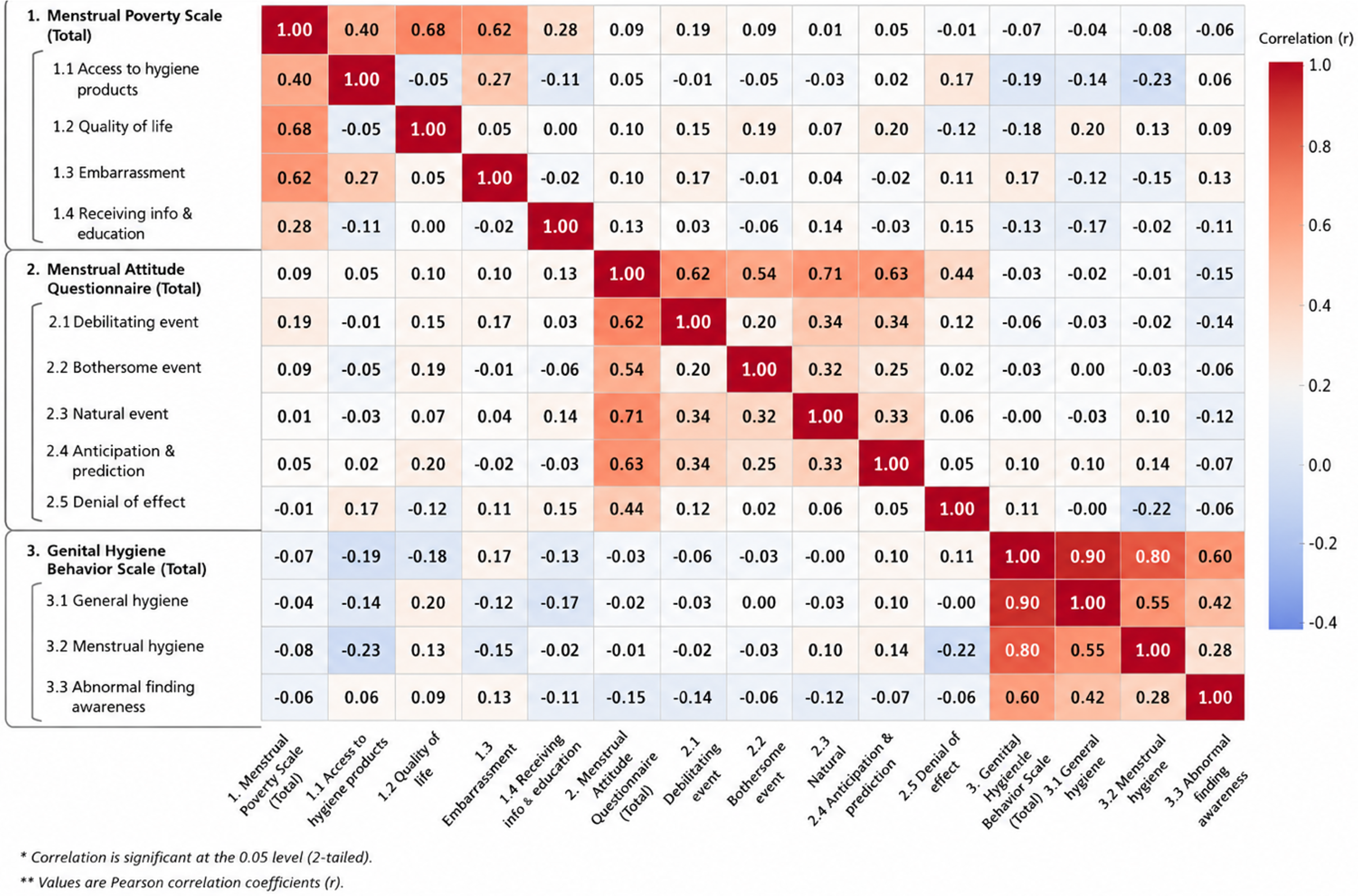
The correlations between the MPS, MAQ, and GHBS are illustrated in the heatmap (Fig. 1). Menstrual poverty showed a weak but significant positive correlation with the Menstruation as a Debilitating Event subscale (r = 0.187, p<0.05) and no significant association with the total scores of the other scales. Access to Hygiene Products subscale was negatively associated with General hygiene (r= -0.144, p<0.05) and Menstrual Hygiene (r= -0.231, p<0.05). At the subscale level, Menstruation as a Debilitating Event was negatively correlated with Abnormal Finding Awareness (r = –0.140, p<0.05), while Menstruation as a Natural Event was positively correlated with Menstrual Hygiene (r = 0.140, p<0.05). The Denial of Any Effect of Menstruation subscale showed a weak negative correlation with both the GHBS total score (r = –0.111, p < 0.05) and the Menstrual Hygiene subscale (r = –0.221, p < 0.05).
As shown in Table III, the GHBS scores differed significantly by family monthly income (F = 3.037, p = 0.048), with higher scores among participants whose income was lower than expenses compared to those whose income exceeded expenses. Menstrual regularity was also significantly associated with GHBS scores (t = –3.219, p < 0.001), with higher scores in participants reporting irregular menstruation. Additionally, the MPS scores varied significantly according to the main barrier to obtaining menstrual products (F = 3.523, p = 0.016), with the highest scores observed among those citing economic reasons as the main barrier. No other socio-demographic or menstrual characteristics were significantly related to the scale scores.
|
p< 0.05 indicates statistical significance. * One-way ANOVA. **Independent Samples t-test SD: standard deviation. |
||||||||||
| Table III. Comparison of scale scores according to socio-demographic and menstrual characteristics. | ||||||||||
| Variable | Categories |
|
|
|
|
|
|
|||
|
|
|
|
|
|
|
|||||
| Family monthly income | Income < expenses |
|
|
|
|
|
|
|
|
|
| Income = expenses |
|
|
|
|||||||
| Income > expenses |
|
|
|
|||||||
| Menstrual regularity | Yes |
|
|
|
|
|
|
|
|
|
| No |
|
|
|
|||||||
| Main barrier to obtaining products | Economic reasons |
|
|
|
|
|
|
|
|
|
| Product unavailability |
|
|
|
|||||||
| Social stigma/shame |
|
|
|
|||||||
The multiple linear regression analyses are presented in Table IV. In the model examining menstrual poverty, paternal education, the perceived main barrier to obtaining menstrual products, MAQ total score, and GHBS total score were included as independent variables. The model was statistically significant and explained 6.9% of the variance in menstrual poverty scores (R2 = 0.069, adjusted R2 = 0.037, F(7, 207) = 2.183, p =0.037). Compared with participants who identified economic reasons as the main barrier, those who identified social stigma or shame had significantly lower menstrual poverty scores (B = −3.195, 95% confidence interval −5.331, −1.060, β = −0.226, p=0.004). No other variable was a statistically significant independent predictor of menstrual poverty.
| Table IV. Multiple linear regression analyses of factors associated with menstrual poverty and genital hygiene behaviors among adolescents (n = 215) | |||||
|---|---|---|---|---|---|
| Independent variables |
|
|
|
|
|
|
All variables were entered simultaneously using the enter method. Bold p values indicate statistical significance at p < .05. Reference categories: ᵃuniversity or above, ᵇeconomic reasons, cliving with family, ᵈincome equal to expenses, ᵉuniversity or above, fregular menstruation, ᵍreceived menstrual education, B = unstandardized regression coefficient; β = standardized regression coefficient; CI = confidence interval; SE = standard error. |
|||||
| Table IV. Multiple linear regression analyses of factors associated with menstrual poverty and genital hygiene behaviors among adolescents (n = 215). | |||||
| Independent variables |
|
|
|
|
|
| Model 1. Dependent variable: menstrual poverty scale total score | |||||
| Father’s educationᵃ | |||||
| Primary school |
|
|
|
|
|
| Secondary school |
|
|
|
|
|
| High school |
|
|
|
|
|
| Main barrier to obtaining menstrual productsᵇ | |||||
| Product unavailability |
|
|
|
|
|
| Social stigma/shame |
|
|
|
|
|
| Menstrual Attitude Questionnaire total score |
|
|
|
|
|
| Genital Hygiene Behavior Scale total score |
|
|
|
|
|
| Model statistics |
|
||||
| Model 2. Dependent variable: Genital Hygiene Behavior Scale total score | |||||
| Age, years |
|
|
|
|
|
| Dormitory residencec |
|
|
|
|
|
| Family monthly incomeᵈ | |||||
| Income lower than expenses |
|
|
|
|
|
| Income higher than expenses |
|
|
|
|
|
| Mother’s educationᵉ | |||||
| Primary school |
|
|
|
|
|
| Secondary school |
|
|
|
|
|
| High school |
|
|
|
|
|
| Irregular menstruationf |
|
|
|
|
|
| No menstrual educationᵍ |
|
|
|
|
|
| Menstrual Poverty Scale total score |
|
|
|
|
|
| Menstrual Attitude Questionnaire total score |
|
|
|
|
|
| Model statistics |
|
||||
In the model examining genital hygiene behaviors, age, living arrangement, family monthly income, maternal education, menstrual regularity, receipt of menstrual education, MPS total score, and MAQ total score were included. The model was statistically significant and explained 12.9% of the variance in genital hygiene behavior scores (R2 = 0.129, adjusted R2 = 0.081, F(11, 203) = 2.722, p =0.003). Menstrual irregularity was the only statistically significant independent predictor. Participants reporting irregular menstruation had genital hygiene behavior scores approximately 5.26 points higher than those reporting regular menstruation (B = 5.258, 95% confidence interval [2.232-8.284], β = 0.230, p=0.001). Family monthly income, menstrual poverty, and menstrual attitudes were not independently associated with genital hygiene behavior scores in the adjusted model.
Discussion
This study investigated the interrelations among menstrual poverty, menstrual attitudes, and genital hygiene behaviors in adolescents, alongside the influence of socio-demographic factors. The majority of participants resided with their families and identified their mothers as the primary source of menstrual information, highlighting the family’s pivotal role in menstrual health education. The low percentage of participants citing teachers or health professionals as information sources underscores deficiencies in formal education. Although nearly half of the participants reported household income matching expenses, economic constraints were the predominant barrier to accessing menstrual products. In the present study, households where income equaled expenses were considered to reflect moderate financial status, as this categorization was based on participants’ own perceptions of their financial situation rather than an objective income measure. These findings suggest that menstrual poverty may also impact adolescents from households with limited but balanced financial resources, consistent with previous literature.7,14,15,24,25 All participants reported using pads, while the lack of alternative products (e.g., tampons, menstrual cups) may be attributed to cultural or accessibility barriers.26
The MPS score was moderate, with the lowest scores in product access, consistent with previous studies.13,14 In the MAQ, the highest mean score was observed in the Anticipation and Prediction subscale, and the lowest in the denial of any effect, corroborating Fışkın Siyahtaş et al.26 Elevated scores in the debilitating and bothersome subscales indicated predominantly negative perceptions, in agreement with Borges et al.16 The GHBS mean score was comparable to earlier research.27-32 While general and menstrual hygiene practices were deemed adequate, low scores in awareness of abnormal findings highlighted a limited recognition of unusual symptoms, supporting the findings of Tshivule et al.10
Correlation analyses revealed weak associations between menstrual attitudes and hygiene behaviors. The denial of any effect subscale showed weak but statistically significant negative correlations with both the GHBS total score and the Menstrual Hygiene subscale, suggesting that adolescents who tend to deny any effect of menstruation may engage in slightly less attentive menstrual hygiene practices. However, given the weakness of these correlations, these findings should be interpreted with caution. A modest positive correlation was identified between anticipation and prediction and general hygiene, suggesting that awareness of menstrual signs may enhance hygiene practices, aligning with previous research conducted in India.32 Conversely, perceiving menstruation as a debilitating event was negatively associated with awareness of abnormal findings, though the weak correlation coefficient suggests that this association should be interpreted with caution and does not allow for strong conclusions regarding attentiveness to health warning signs. Ghiasi et al.33 similarly reported that viewing menstruation as “debilitating” was linked to lower symptom awareness and poorer self-care. Overall, menstrual attitudes appear to exert a limited influence on hygiene behaviors, which are more strongly shaped by structural and contextual determinants. This pattern is consistent with a social-ecological perspective, which posits that individual behaviors are embedded within broader environmental, institutional, and socioeconomic systems.2 From this standpoint, even adolescents with positive menstrual attitudes may be unable to maintain adequate hygiene practices in the absence of affordable products, functional sanitation infrastructure, or supportive school and family environments. Conversely, structural barriers such as economic hardship and limited access to products may override the potential positive influence of attitudes on behavior. These findings suggest that attitude-focused interventions alone are unlikely to be sufficient, and that structural level changes (including ensuring affordable product access, improving school sanitation facilities, and strengthening family and community support systems) are essential prerequisites for meaningful improvements in adolescent menstrual hygiene behaviors.
Research has documented a correlation between women’s monthly income and their genital hygiene behaviors.26 Higher scores in genital hygiene behaviors among women with elevated income levels have been linked to improved living conditions, enhanced access to health services, and increased hygienic practices facilitated by greater economic resources.34 In the present study, an unexpected relationship was identified between family income and genital hygiene behaviors. Adolescents from households where expenses surpassed income reported higher hygiene scores compared to those from households with greater financial resources. This unexpected finding is difficult to interpret with certainty given the cross-sectional design of the study and the absence of qualitative data on participants’ hygiene motivations. One possible explanation is that adolescents from financially constrained households may develop greater awareness of hygiene as a low-cost protective behavior; however, this interpretation remains speculative and should be tested in future research. It is also plausible that unmeasured variables, such as household crowding, access to water and sanitation facilities, or maternal health literacy, may confound this relationship. Similar paradoxical results have been observed in previous studies, suggesting a possible, though modest, association between awareness of menstrual signs and hygiene practices; however, the weak correlation coefficient warrants caution in inferring a directional or causal relationship. Conversely, other studies have reported no significant correlation between monthly income and the mean scores of women’s genital hygiene behaviors.25 Although family income was associated with genital hygiene behavior scores in the unadjusted comparison, this association was no longer statistically significant after age, living arrangement, maternal education, menstrual regularity, menstrual education, menstrual poverty, and menstrual attitudes were considered simultaneously. This suggests that the observed income-based differences may partly reflect the influence of other individual or contextual characteristics. Therefore, family income should not be interpreted as an independent determinant of genital hygiene behaviors in the present sample.
Menstrual regularity remained the only statistically significant independent predictor of genital hygiene behaviors in the adjusted model. Adolescents with irregular menstrual cycles had higher genital hygiene behavior scores than those with regular cycles. One possible explanation is that irregular menstruation may increase attention to bodily changes and encourage more deliberate hygiene practices. However, because of the cross-sectional design, the direction of this relationship cannot be established. Furthermore, the modest explanatory power of the model indicates that menstrual regularity accounts for only a limited proportion of variation in hygiene behaviors. Similarly, previous studies have indicated that menstrual irregularities can heighten adolescents’ awareness and attentiveness regarding menstrual management.35-37 Regression analysis similarly identified menstrual regularity as a statistically significant predictor of genital hygiene behaviors, though the modest explained variance suggests that this relationship should be interpreted with caution.
Adolescents who identified economic reasons as barriers to accessing menstrual products exhibited significantly higher menstrual poverty scores compared to those who attributed their challenges to product unavailability or social stigma. Economic barriers remained relevant to menstrual poverty; however, the adjusted analysis showed that adolescents identifying economic reasons as the primary barrier had higher menstrual poverty scores than those identifying social stigma or shame. Similar patterns have been observed in low- and middle-income countries, where financial limitations are closely linked to restricted access to menstrual products and adverse menstrual health outcomes.38,39 Regression analysis supported this finding; however, the low explained variance indicates that economic barriers, while statistically significant, account for only a small proportion of the variability in menstrual poverty scores, suggesting that additional unmeasured factors may also play an important role. Nevertheless, the relatively low explained variance in both models indicates that menstrual poverty and hygiene behaviors cannot be fully explained by individual or socio-demographic characteristics alone. These findings highlight the importance of considering environmental and contextual factors-such as school settings, family support, and broader social norms-in shaping adolescent menstrual health outcomes.
This study highlights the multidimensional nature of adolescent menstrual health. The regression analyses showed that identifying social stigma or shame rather than economic reasons as the primary barrier was associated with lower menstrual poverty scores, while menstrual irregularity was the only independent predictor of genital hygiene behaviors. Menstrual attitudes and the other scale scores did not independently predict the outcomes after relevant sociodemographic and menstruation-related characteristics were considered. The modest explanatory power of both models indicates that menstrual poverty and genital hygiene behaviors are likely shaped by broader structural, familial, educational, and environmental factors that were not fully captured in the present study. Interventions should therefore combine affordable product access with comprehensive menstrual education and supportive school and family environments.
Limitations
Several limitations of this study should be acknowledged. Participants were recruited through online convenience sampling via WhatsApp, targeting high school students in Istanbul, Türkiye. This approach may have introduced selection bias, as students without internet access or smartphone use were systematically excluded. Furthermore, the voluntary nature of participation may have resulted in volunteer bias, whereby adolescents with greater awareness of or interest in menstrual health were more likely to participate, potentially overestimating positive attitudes and hygiene behaviors in the sample. Additionally, as the sample was drawn exclusively from high school students in Istanbul, the findings may not be generalizable to adolescents in other regions of Türkiye or to those not enrolled in formal education. These factors limit the representativeness of the findings, and caution should be exercised when generalizing the results to the broader Turkish adolescent population. Additionally, the socioeconomic distribution of the sample was uneven, with only 4.7% of participants reporting household income below expenses. This underrepresentation of lower-income adolescents may have limited the ability to adequately evaluate the relationship between socioeconomic disadvantage and menstrual poverty, and caution should be exercised when interpreting findings related to income-based comparisons.
Ethical approval
This study was approved by the Istanbul University Social and Human Sciences Research Ethics Committee (Date: 26.02.2025; No: 2025/46). Informed consent form was added to the beginning of the online questionnaire. All participants were fully informed about the aim and procedures of the study, and their voluntary participation was ensured through the collection of written informed consent. The study was conducted in accordance with the ethical standards of the Declaration of Helsinki.
Source of funding
The authors declare the study received no funding.
Conflict of interest
The authors declare that there is no conflict of interest.
References
- World Health Organization (WHO). Adolescent health. WHO; 2025. Available at: https://www.who.int/health-topics/adolescent-health#tab=tab_1 (Accessed on Aug 13, 2025).
- Hennegan J, Caruso BA, Zulaika G, et al. Indicators for national and global monitoring of girls’ menstrual health and hygiene: development of a priority shortlist. J Adolesc Health 2023; 73: 992-1001. https://doi.org/10.1016/j.jadohealth.2023.07.017
- Sommer M, Hirsch JS, Nathanson C, Parker RG. Comfortably, safely, and without shame: defining menstrual hygiene management as a public health issue. Am J Public Health 2015; 105: 1302-1311. https://doi.org/10.2105/AJPH.2014.302525
- UN Women. Social protection systems, access to public services and sustainable infrastructure for gender equality and the empowerment of women and girls: 2019 commission on the status of women agreed conclusions. UN Women; 2019.
- Sebert Kuhlmann A, Key R, Billingsley C, Shato T, Scroggins S, Teni MT. Students’ menstrual hygiene needs and school attendance in an urban St. Louis, Missouri, District. J Adolesc Health 2020; 67: 444-446. https://doi.org/10.1016/j.jadohealth.2020.05.040
- Suleman A, Krishna S, Krishnakumar D, Nemoto K, Nguyễn MLT, Mehta SD. A pilot survey of students’ menstrual attitudes, experiences, and needs on an urban university campus. Womens Health (Lond) 2024; 20. https://doi.org/10.1177/17455057241254713
- Rossouw L, Ross H. Understanding period poverty: socio-economic inequalities in menstrual hygiene management in eight low- and middle-income countries. Int J Environ Res Public Health 2021; 18: 2571. https://doi.org/10.3390/ijerph18052571
- World Health Organization (WHO). WHO statement on menstrual health and rights. WHO; 2022. Available at: https://www.who.int/news/item/22-06-2022-who-statement-on-menstrual-health-and-rights (Accessed on Aug 13, 2025).
- World Health Organization (WHO). Global report reveals major gaps in menstrual health and hygiene in schools. WHO; 2024. Available at: https://www.who.int/news/item/28-05-2024-global-report-reveals-major-gaps-in-menstrual-health-and-hygiene-in-schools (Accessed on Aug 13, 2025).
- Tshivule MZ, Rasweswe MM, Mothiba TM, Bopape MA. Factors influencing menstrual hygiene knowledge, attitudes, and practices among adolescent girls in African rural schools: scoping review. Front Reprod Health 2025; 7. https://doi.org/10.3389/frph.2025.1553101
- Deniz AO, Acikgoz S. Menstrual poverty and genital hygiene behaviors among adolescents: a cross-sectional study. J Pediatr Nurs 2025; 80: e1-e6. https://doi.org/10.1016/j.pedn.2024.10.028
- Tatar AE, Pehlivantürk Kızılkan M, Erdem Torun Ş, et al. Exploring menstrual poverty and its impact on adolescent mental health. Sex Health 2026; 23. https://doi.org/10.1071/SH25196
- Wolff C, Waselewski M, Amaro X, Amanze C, Frank A, Chang T. Youth perspectives and experiences with menstruation and period poverty. J Adolesc Health 2024; 75: 140-146. https://doi.org/10.1016/j.jadohealth.2024.02.018
- Marí-Klose M, Julià A, Escapa S, Gallo P. Period poverty and mental health in a representative sample of young women in Barcelona, Spain. BMC Womens Health 2023; 23: 201. https://doi.org/10.1186/s12905-023-02328-w
- UN Women. Period poverty - why millions of girls and women cannot afford their periods. Un Women; 2025. Available at: https://www.unwomen.org/en/articles/explainer/period-poverty-why-millions-of-girls-and-women-cannot-afford-their-periods (Accessed on Aug 13, 2025).
- Borges ALV, Chofakian CBDN, Cabral CDS, Ramaiya A. Understanding the association between menstrual health and hygiene attitudes and personal agency among very young adolescents in Sao Paulo, Brazil: a cross-sectional study. Womens Health (Lond) 2024; 20: 17455057241274895. https://doi.org/10.1177/17455057241274895
- Rosenstock IM. The health belief model and preventive health behavior. Health Educ Monogr 1974; 2: 354-386. https://doi.org/10.1177/109019817400200405
- Bandura A. Self-efficacy: the exercise of control. New York: W.H. Freeman; 1997.
- Ajzen I. The theory of planned behavior. Organ Behav Hum Decis Process 1991; 50: 179-211. https://doi.org/10.1016/0749-5978(91)90020-T
- Öz Yildirim Ö, Hendekci A, Aydın Avci I. Menstrual poverty scale: reliability and validity study. Women Health 2024; 64: 526-536. https://doi.org/10.1080/03630242.2024.2375382
- Brooks-Gunn J, Ruble DN. The menstrual attitude questionnaire. Psychosom Med 1980; 42: 503-512. https://doi.org/10.1097/00006842-198009000-00005
- Kulakaç Ö, Öncel S, Fırat MZ, Akcan A. Menstrual attitude questionnaire: validity and reliability study. Turkiye Klinikleri Journal of Gynecology and Obstetrics 2008; 18: 347-356.
- Karahan N. Development of a genital hygiene behavior scale: validity and reliability study. Istanbul Med J 2017; 18: 157-162. https://doi.org/10.5152/imj.2017.82957
- Bulut A, Yiğitbaş Ç, Çelik G. Genital hygiene behaviors from perspective of nursing students. Medical Journal of Ankara Training and Research Hospital 2019; 52: 227-232.
- Hadımlı A, Akan A, Kardeş G, Akkurt B, Saydam BK. Determination of menstrual hygiene management and genital hygiene behaviors of students: a university example from Turkey. Rev Esc Enferm USP 2024; 58: e20240113. https://doi.org/10.1590/1980-220X-REEUSP-2024-0113en
- Fışkın Siyahtaş G, Altay BN, Erdem M. The relationship between women’s menstrual attitudes levels and menstruation symptoms. Turkish Journal of Family Medicine and Primary Care 2024; 18: 426-432. https://doi.org/10.21763/tjfmpc.1430026
- Demirag H, Hintistan S, Cin A, Tuncay B. Investigation of genital hygiene behaviors of health services vocational school students. Bozok Medical Journal 2019; 9: 42-50. https://doi.org/10.16919/bozoktip.446246
- Kartal YA, Engin B, Teke B. Genital hygiene behaviors of midwifery students. International Journal of Caring Sciences 2020; 13: 2029-2036.
- Göger B, Tuncay B. Investigation of personal and genital hygiene behaviors of female students who stayed in boarding during the adolescent period. Journal of Samsun Health Sciences 2021; 6: 255-269. https://doi.org/10.47115/jshs.902503
- Kuruc HS, Avci N. Evaluation of genital hygiene behaviors of female secondary school students in Türkiye. Journal of Clinical Medicine of Kazakhstan 2024; 21: 80-88. https://doi.org/10.23950/jcmk/14399
- Uyanık A. Investigation of university students’ genital hygiene behaviors and access to genital hygiene products. Bingöl University Journal of Health 2023; 4: 234-242. https://doi.org/10.58605/bingolsaglik.1395974
- Singh G, Gupta A, Anand N, Kumar R. Determinants of menstrual hygiene among adolescent school girls in a rural area of Patna, Bihar, India: a cross-sectional study. J Family Med Prim Care 2023; 12: 3271-3278. https://doi.org/10.4103/jfmpc.jfmpc_891_23
- Ghiasi A, Keramat A, Mollaahmadi L. The relationship between attitudes toward menstruation and perimenstrual symptoms among female students of Shahroud University of Medical Sciences, Northeast Iran. Shiraz E-Med J 2018; 19: e65714. https://doi.org/10.5812/semj.65714
- Karahan N, Aydemir G, Şahin ET. Genital hygiene behaviors in women: a cross-sectional study from Turkey. Rev Assoc Med Bras 2025; 71: e20241760. https://doi.org/10.1590/1806-9282.20241760
- Betsu BD, Medhanyie AA, Gebrehiwet TG, Wall LL. Menstrual hygiene management interventions and their effects on schoolgirls’ menstrual hygiene experiences in low and middle countries: a systematic review. PLoS One 2024; 19: e0302523. https://doi.org/10.1371/journal.pone.0302523
- Nnennaya EU, Atinge S, Dogara SP, Ubandoma RJ. Menstrual hygiene management among adolescent school girls in Taraba State, Nigeria. Afr Health Sci 2021; 21: 842-851. https://doi.org/10.4314/ahs.v21i2.45
- Shah V, Nabwera HM, Sosseh F, et al. A rite of passage: a mixed methodology study about knowledge, perceptions and practices of menstrual hygiene management in rural Gambia. BMC Public Health 2019; 19: 277. https://doi.org/10.1186/s12889-019-6599-2
- Hennegan J, Shannon AK, Rubli J, Schwab KJ, Melendez-Torres GJ. Women’s and girls’ experiences of menstruation in low- and middle-income countries: a systematic review and qualitative metasynthesis. PLoS Med 2019; 16: e1002803. https://doi.org/10.1371/journal.pmed.1002803
- van Eijk AM, Sivakami M, Thakkar MB, et al. Menstrual hygiene management among adolescent girls in India: a systematic review and meta-analysis. BMJ Open 2016; 6: e010290. https://doi.org/10.1136/bmjopen-2015-010290
Copyright and license
Copyright © 2026 The Author(s). This is an open access article distributed under the Creative Commons Attribution License (CC BY), which permits unrestricted use, distribution, and reproduction in any medium or format, provided the original work is properly cited.